
Selecting the right video camera and tripod depends on whether you prioritize professional image sensors for creative work or simple, all-in-one convenience for daily recording. The biggest difference between these options is the depth of control; some offer interchangeable lenses for specific visual styles, while others provide a complete, ready-to-use kit for quick setup.
Best overall: Canon EOS R10 Kit, which offers advanced subject detection and high-speed shooting, making it a powerful choice for both sports and everyday video content creation.
Best for creators: Sony ZV-E10 II, which provides a high-resolution sensor and dedicated vlogging features like a vari-angle screen to help you capture professional-looking footage with ease.
Best for stability: K&F Concept 80-inch Tripod, which uses a fluid head design to ensure smooth panning and tilting, essential for anyone needing professional, shake-free camera movements.
This guide is for anyone looking to balance high-quality video capture with the support tools needed to stabilize their shots.
How We Picked
We analyzed sixteen Amazon listings to identify capable video cameras and tripods for various skill levels. Each product was selected for its clear specifications regarding sensor technology, physical dimensions, or weight capacity. We prioritized bundles that include essential accessories to help beginners get started immediately, excluding items that lacked detailed feature information.
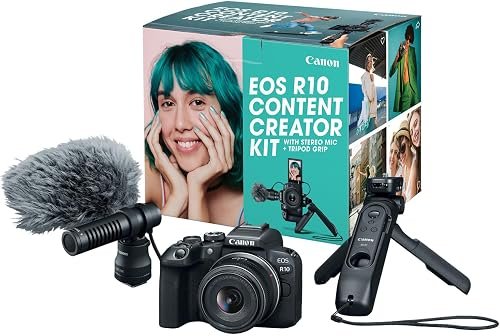
1. Canon EOS R10 Content Creator Kit

Best for: Creators needing high-speed performance and advanced subject tracking.
The Canon EOS R10 Kit is built for those who want professional-grade 4K video without complex setups. It features a 24.2-megapixel sensor that handles various lighting conditions, while the included RF-S18-150mm lens provides enough range for most filming scenarios. Because it uses the DIGIC X processor, you can shoot continuously without worrying about common recording limits. Unlike many entry-level models, this camera doesn’t stop recording after 30 minutes, allowing for longer sessions.
This camera is an ideal entry-level choice for someone who wants to grow their skills, as it supports the full range of RF-S, RF, EF, and EF-S mounts. If you plan to capture fast-moving subjects, use the 30fps electronic shutter or RAW Burst Mode with 1/2-second pre-shooting to ensure you never miss the action. However, it may feel too feature-rich for a casual user who just wants a simple “point and shoot” device. The compact design ensures it remains portable for travel, but the firm grip makes it feel sturdy during handheld recording.
Pros
- Advanced animal and vehicle detection
- High-speed 15 fps mechanical shutter
- No 30-minute recording limit
Cons
- May be complex for beginners
- Lens system requires extra investment
2. Sony ZV-E10 II + 16-50mm Lens

Best for: Vloggers who need professional audio and video quality.
The Sony ZV-E10 II is designed specifically for content creators, featuring a 26MP sensor that excels in low-light environments. The flip-out LCD screen and built-in microphone simplify the vlogging process, allowing you to monitor your framing and audio levels in real-time. It records 4K video with full pixel readout, which ensures that your final clips capture fine details without loss of quality.
Because it uses the E-mount system, you have access to a vast array of lenses. The inclusion of a neutral density filter is a significant advantage for filming in bright outdoor conditions, as it helps maintain proper exposure settings. This camera isn’t intended for those who prefer an optical viewfinder, as it relies entirely on the screen for composition.
Pros
- High-resolution 26MP APS-C sensor
- Real-time eye autofocus tracking
- Built-in neutral density filter
Cons
- Relies on screen for composition
- Menu system requires learning curve
3. Sony ZV-E10 + 16-50mm Lens

Best for: Travelers wanting a compact, all-in-one vlogging solution.
The Sony ZV-E10 offers a reliable 24.2MP sensor and a powerful BIONZ X processor in a portable body. It includes a variety of creative modes like slow motion and time-lapse, giving you more ways to express your style without needing to edit on a computer. The vari-angle screen is a staple feature that makes filming yourself much easier than with fixed-screen cameras.
The bundle comes with a 128GB memory card and a tripod, which means you can start filming immediately after unboxing. If you’re an experienced videographer looking for specific high-end cinema features like internal 10-bit color, you might find this model limited. It’s a robust, well-rounded choice for those who value speed and ease of use.
Pros
- Includes comprehensive vlogging bundle
- Fast, accurate eye autofocus
- Portable for travel use
Cons
- Lacks high-end cinema color profiles
- Included lens has limited zoom
4. Panasonic HC-V770 Full HD Camcorder with 64GB SD Card

Best for: Users who need long-range zooming capabilities.
The Panasonic HC-V770 is a traditional camcorder that focuses on high-powered zoom and image stability. Its 20x optical zoom allows you to capture subjects from a distance without losing clarity, which is often difficult for mirrorless cameras. The HDR movie function is a standout, as it combines two exposures to balance bright and dark areas, resulting in clearer footage in high-contrast scenes.
The wireless twin camera feature allows you to use your smartphone as a secondary angle, which is perfect for interviews or family events. If you’re looking for a camera with a large sensor for cinematic depth-of-field, this camcorder isn’t the right fit, as its design prioritizes zoom and ease of operation. It’s a straightforward tool for those who prefer a dedicated video device over a hybrid camera.
Pros
- Powerful 20x optical zoom
- HDR movie function for detail
- Includes 64GB memory card
Cons
- Smaller sensor than mirrorless options
- Less control over depth-of-field
5. K&F CONCEPT 80″ Video Tripod with Fluid Head

Best for: Professionals needing smooth panning and tilting.
The K&F Concept 80-inch Tripod features a fluid head supporting 360-degree horizontal pans and -70 to +90-degree vertical tilts. This range eliminates the jerky motion common in standard heads, ensuring your footage remains steady during complex tracking shots. If you’re left-handed, you can detach the handle and move it to the side that feels most natural for your workflow.
The aluminum alloy frame relies on a triangle mid-spreader to maintain rigidity. This design is critical when you extend the three-section legs to the maximum 79.5-inch height. While it supports up to 17.6 pounds, the listing doesn’t mention the consequences of exceeding this limit. If your setup feels unstable, check that the flip locks are fully engaged, as loose locks will cause vibration during long focal length shots.
The quick-release plate includes both 1/4-inch and 3/8-inch screws to accommodate nearly any DSLR or camcorder. You can even mount a camera slider directly to the head for cinematic movement. Though the tripod folds down to 36.2 inches, its size makes it better suited for studio or car-based shoots rather than backcountry hiking.
Pros
- Fluid head for smooth video
- Sturdy aluminum alloy frame
- Quick-release plate included
Cons
- Heavy for long hikes
- Large footprint when extended
6. 5K UHD Vlogging Camera

Best for: Beginners who want a complete, ready-to-use kit.
The 5K UHD Vlogging Camera is an entry-level camcorder that aims to simplify the creation process by including everything in one box. It shoots 5K video at 20fps or 4K at 60fps and features a 270-degree rotatable screen, which is helpful for filming from awkward angles or for group shots. The inclusion of IR night vision allows for shooting in low-light environments, a feature not commonly found in entry-level consumer cameras.
This device is designed for users who want to share content quickly, offering Wi-Fi for easy transfer to mobile devices. Use the 4K/60fps setting for fast-moving subjects to maintain smoothness, or switch to 5K/20fps when you prioritize maximum visual detail for static interviews.
It isn’t designed for professional filmmakers who require high-bitrate recording or advanced lens options. Many beginners mistake this for a cinema-grade primary camera and become frustrated by the lack of manual depth-of-field control. If you need to record for hours, use the recording-while-charging feature to avoid mid-session power failure. For students or beginners starting a YouTube channel, it provides a functional entry point.
Pros
- Includes dual 1800mAh batteries and external mic
- IR night vision for dark settings
- Easy Wi-Fi content sharing
Cons
- Not for professional cinema work
- Limited manual setting control
7. VICTIV 74” Camera Tripod

Best for: Users needing a versatile and lightweight stand.
The VICTIV 74-inch Tripod is a lightweight solution that works well for both cameras and smartphones. With a height range of 19 to 74 inches, it’s adaptable for everything from tabletop product shots to eye-level vlogging. The 3-way pan head allows for precise horizontal and vertical adjustments, which is useful when you need to frame a shot exactly.
Use the 360-degree horizontal pan for wide landscapes, or switch to the 90-degree vertical tilt for portrait-style social media content. If you’re shooting outdoors in windy conditions, hang your backpack from the center weight hook to prevent tipping. This simple addition significantly improves stability for long-exposure photography.
The tripod includes a standard 1/4-inch screw mount, making it compatible with most DSLRs, spotting scopes, and projectors. If you’re switching between a heavy camera and a phone, use the included universal phone holder to swap devices in seconds. Keep the extra quick-release plate in your bag; losing your only plate mid-shoot is a common mistake that forces you to stop working entirely.
It isn’t designed to support heavy professional cinema rigs, but it’s more than enough for mirrorless cameras and phones. This is an excellent choice for someone who needs a reliable, easy-to-carry stand for daily content creation.
Pros
- Lightweight and easy to carry
- Includes universal phone mount
- Height reaches 74 inches
Cons
- Not for heavy camera rigs
- Plastic components in head assembly
How to Choose in Sixty Seconds
Which camera sensor size matters most for my videos?
Larger sensors, like the APS-C sensors found in the Sony ZV-E10 and Canon EOS R10, generally perform better in low light and provide more control over background blur. Smaller sensors, typical in traditional camcorders like the Panasonic HC-V770, prioritize zoom range and ease of use over cinematic depth. If you want a professional look with blurred backgrounds, choose the larger sensor. If you’re filming events from far away and need maximum reach, a camcorder is the better choice for your workflow.
Do I really need a tripod with a fluid head?
A fluid head is the standard choice for video because it uses internal resistance to make your camera pans and tilts feel smooth and professional. If you use a standard photography tripod head, your movements will likely appear jerky and sudden. For those who record interviews, landscapes, or slow-moving subjects, the ISO 12232:2019 standards for camera sensitivity and image quality are often best met when the camera is kept perfectly still during the recording process.
What should I check before buying a camera bundle?
Check the compatibility of the included accessories with your specific needs. Look at the microphone type to ensure it will provide the audio quality you expect for your content. Verify that the tripod included in a bundle has the weight capacity to hold your camera securely, especially if you plan to use larger lenses. Always ensure the memory card included is fast enough to handle the video resolution you intend to record, as 4K video requires higher data write speeds than standard HD.
Related guides
Frequently Asked Questions
What happens if I use a lens not designed for my camera?
Using an incompatible lens can prevent autofocus from working or cause mechanical damage to the lens mount. The Canon EOS R10 and Sony models use specific proprietary mounts, meaning you must use lenses designed for that brand or use a verified adapter. Always check the manufacturer’s compatibility list before attempting to attach a different lens.
How often should I replace the batteries in my camera?
Battery life depends on your recording settings, such as resolution and brightness of the screen. Most modern cameras like the Sony ZV-E10 II are designed for efficient power use, but you should always carry a spare, especially for long outdoor shoots.
What is the first part of a camera setup to wear out?
The most common points of failure in a video setup are the cables and the tripod locking mechanisms. Similarly, the flip locks or twist locks on tripods like the VICTIV 74-inch Tripod require regular cleaning to maintain their performance, as grit and dust can accumulate during outdoor use.
Is the simplest camcorder on this list enough for YouTube?
The 5K UHD Vlogging Camera is a capable, all-in-one setup for YouTube beginners. It includes a microphone and tripod, providing the necessary resolution for web streaming. While it lacks the advanced lens options of the Canon EOS R10, it removes technical barriers to help you focus on your content.


