
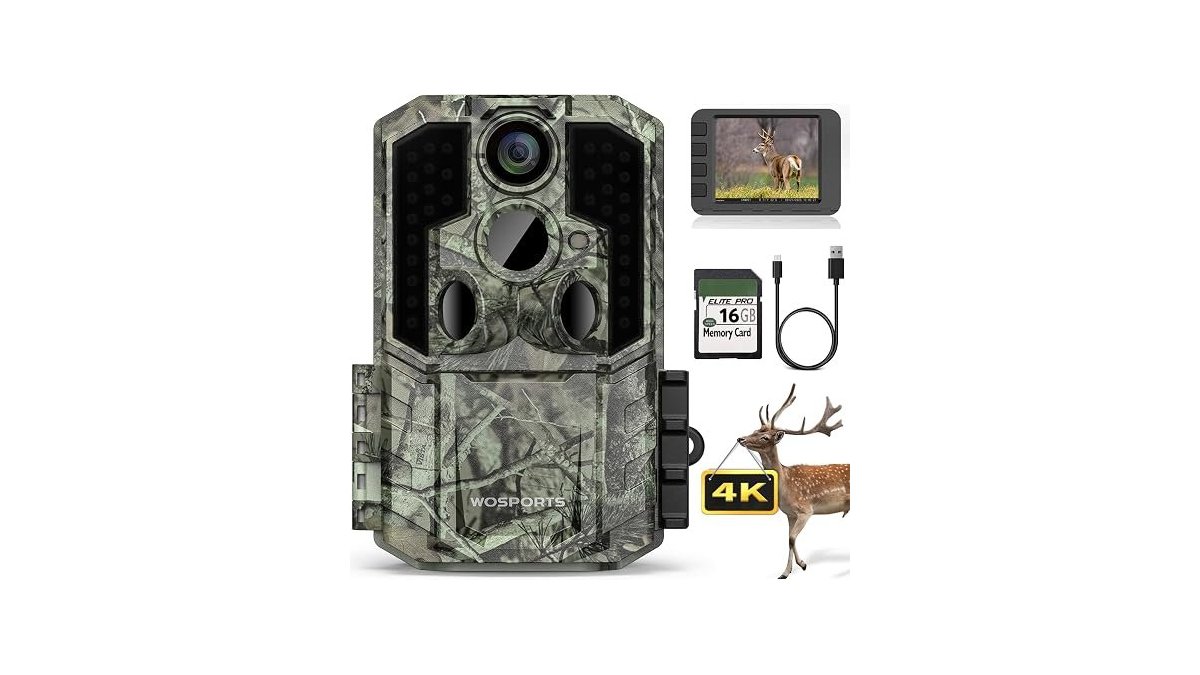
Choosing the right trail camera depends on whether you value high-resolution video, stealthy night vision, or a compact design for easy concealment. These devices are separated by their sensor quality, trigger speeds, and whether they offer built-in screens for on-site playback, which removes the need to carry your footage home to check it.
Best overall: WOSPORTS Trail Camera offers a balance of 64MP photo clarity and 4K video, plus a built-in screen that lets you check footage without moving the card. Best for hunting stealth: Meidase P70 uses 940nm no-glow LEDs that remain invisible to animals at night, ensuring your presence stays hidden during long-term monitoring. Best compact option: OUTDOOR EXPERT Game Camera features a mini exterior design that’s roughly half the size of standard models, making it ideal for discreet placement.
How We Picked
We compared 48 different Amazon listings to identify models that provide reliable, non-cellular wildlife monitoring. To earn a place in this article, a camera had to clearly state its trigger speed, megapixel count for photos, and its power requirements. We prioritized models that include a built-in LCD screen for immediate playback, as this feature is essential for users who want to verify their camera’s positioning in the field without needing a separate card reader. We excluded any models that lacked clear specifications regarding their waterproof ratings or infrared illumination range.
1. WOSPORTS Trail Camera(Non-Cellular Non-WiFi) 64MP 4K 0.2S Trigger Motion Activated

Best for: General wildlife observation and property surveillance.
The WOSPORTS Trail Camera is designed for users who want high-resolution captures in both day and night settings. Its 64MP photo capability and 4K video recording ensure that you get detailed images, which is helpful when you need to identify specific wildlife or monitor a home perimeter. The 0.2-second trigger speed means the camera reacts quickly to movement, capturing action before it passes out of frame.
The inclusion of an LCD screen is a major convenience, as it allows you to adjust settings and preview your media while you’re still in the woods. Because it uses 940nm infrared LEDs, the night vision is non-glowing, which prevents the bright flashes that can startle animals. You can power it using 8 AA batteries, though it also supports external power solutions like solar panels if you prefer not to change batteries frequently.
Pros
- High 64MP resolution for sharp photos.
- Built-in LCD screen for easy playback.
- No-glow night vision avoids startling animals.
Cons
- Batteries aren’t included in the box.
- Requires external power for long-term use.
2. GardePro E5S Non-Cellular Trail Camera

Best for: Fast-moving wildlife tracking.
The GardePro E5S stands out for its lightning-fast 0.1s trigger speed, which is enabled by three dedicated PIR sensors. This configuration is built specifically for users who need to capture animals moving quickly across a trail, as it minimizes the chance of missing a shot due to a slow sensor. The camera is housed in an IP66-rated shell, meaning it’s designed to handle rain and snow without compromising the internal electronics.
Since this is a non-cellular device, it’s optimized for low power consumption, which helps extend the life of your 8 AA batteries. You must retrieve the SD card to view your footage, which keeps your setup simple and free from the complexity of network configurations. It’s a durable choice for remote locations where you can’t visit to swap batteries very often.
Pros
- Extremely fast 0.1s trigger speed.
- Durable IP66-rated waterproof casing.
- Designed for low power consumption.
Cons
- No built-in screen for playback.
- Batteries must be purchased separately.
3. Meidase P70

Best for: Stealthy night monitoring.
The Meidase P70 uses an f/1.6 aperture lens and advanced image processing to deliver clear 64MP photos and 1296p video. The standout feature is its 100ft no-glow night vision, which utilizes 940nm LEDs to stay completely hidden from wildlife. This makes it an excellent choice for users worried about animals noticing the camera and changing their behavior.
The 0.1s trigger speed is critical for capturing fast-moving game. If you’re monitoring a high-traffic trail, the side sensors detect motion instantly to ensure you never miss a moment.
It also features a 2.4-inch color display, which is one of the larger screens available on this list. This makes navigating the menu and reviewing your captured videos much easier than on models with smaller screens. The camera supports H.264 video compression, which results in smaller file sizes. This ensures you can fit more footage onto your memory card before it fills up.
For long-term deployment, pair the unit with the Meidase SP350 solar panel. If you don’t use the solar panel, you must keep eight AA batteries on hand as a backup power source.
Pros
- Large 2.4-inch color playback screen.
- Invisible no-glow night vision LEDs.
- Efficient H.264 video file compression.
Cons
- Batteries aren’t included with the unit.
- Requires manual SD card retrieval for viewing.
4. SPYPOINT FORCE-4K Trail Camera

Best for: High-definition video recording.
The SPYPOINT FORCE-4K is built for users who prioritize video quality above all else. By capturing footage in 4K with integrated sound, it provides a level of detail that’s useful for analyzing animal behavior or capturing high-quality nature clips. The 66° field of view is slightly narrower than some competitors, which helps focus the camera on a specific trail or feeding spot.
The camera includes a 2-inch LCD screen, allowing you to quickly check your framing and adjust settings on the spot. It offers a 0.4-second trigger speed, which is sufficient for most wildlife scouting needs. The device is designed to save media directly to the SD card, making it a straightforward tool for hunters who want to collect visual data without dealing with apps or cellular signals.
Pros
- High-quality 4K video with sound.
- Integrated 2-inch LCD viewing screen.
- Reliable performance for wildlife monitoring.
Cons
- Trigger speed is slower than top competitors.
- Narrower field of view than some models.
5. GardePro A3S Non-Cellular Trail Camera

Best for: Capturing high-quality audio.
The GardePro A3S is unique because it emphasizes both high-resolution video and audio recording. Using a Sony Starvis sensor, it performs well in low-light conditions, ensuring that your night shots are clearer than those from cameras with standard sensors. The ability to hear natural activity in the field adds a layer of depth to your monitoring that many other models lack.
The camera is highly flexible with its recording modes, offering motion detection, time-lapse, and a hybrid mode that combines both. This allows you to tailor the camera’s behavior to your specific environment, whether you’re watching a game trail or monitoring a backyard. It supports SD cards up to 512GB, which is a large capacity for those who want to leave the camera unattended for long periods.
If you prioritize stealth, rely on the 940nm no-glow infrared. This feature prevents animals from spotting the camera during night operations. Avoid placing the unit in areas with heavy brush, as the 120° wide PIR sensor might trigger false captures from moving branches.
To maximize battery life, use the non-cellular, non-WiFi operation. If you expect high traffic, add the optional solar panel to ensure continuous power.
Pros
- Sony Starvis sensor for low light.
- Records 1296P video with audio.
- Supports very large 512GB SD cards.
Cons
- SD card isn’t included.
- Requires 8 AA batteries separately.
6. Rechargeable Trail Camera
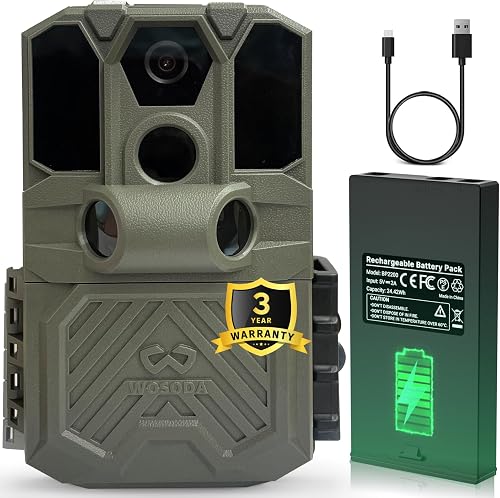
Best for: Users who want a built-in battery.
The WOSODA Rechargeable Trail Camera is a practical pick if you want to avoid buying AA batteries. It includes a 2200mAh lithium battery that you must remove to charge separately. Never attempt to charge the unit via the Type-C port, as this port isn’t designed for power input.
The camera records in 2K resolution and captures 40MP photos, providing a good balance of detail for most scouting applications. The 0.2-second trigger speed ensures that you capture fast-moving subjects effectively within an 80ft range. The housing is IP66 waterproof, designed to withstand harsh outdoor conditions.
The inclusion of a 2-inch LCD display means you can easily format your SD card or update firmware directly on the device. This provides a high level of control, including custom settings like Shot Lag and Target Recording Time. Because the camera stores data locally on an SD card up to 256GB, your footage remains protected from cloud breaches.
Pros
- Includes a rechargeable lithium battery.
- Fast 0.2-second trigger speed.
- IP66 waterproof and dustproof housing.
Cons
- Battery must be removed to charge.
- SD card isn’t included.
7. OUTDOOR EXPERT Game Camera 20MP Mini

Best for: Easy concealment and portability.
The OUTDOOR EXPERT Game Camera is designed for users who need a small, unobtrusive device. Its mini design makes it very easy to hide on trees or fences without alerting people or animals. Despite its small stature, it offers 20MP resolution and 1080P video, which is enough for basic monitoring tasks.
It uses a 940nm no-glow infrared flash for night vision, reaching up to 80 feet. Since it relies on a 6 AA battery setup and a smaller SD card capacity (up to 32GB), it’s best suited for shorter monitoring stints or areas where you can visit frequently to swap the card. The IP66 rating ensures that the small case remains protected from dust and moisture.
If you require remote access, choose a different model. This camera lacks WiFi, cellular connectivity, and app support. You must manually retrieve the micro SD card to review your footage on a computer or reader.
Use this camera when you need to avoid startling wildlife. The invisible infrared LEDs prevent the glow that often scares off animals at night. If your primary goal is high-frequency surveillance, carry extra batteries. The device is optimized for low power consumption, but frequent motion triggers will deplete the 6 AA batteries faster than expected.
Pros
- Very compact and easy to conceal.
- No-glow night vision for stealth.
- Durable, weather-resistant case.
Cons
- Smaller storage limit of 32GB.
- No remote or cellular viewing.
How to Choose in Sixty Seconds
Does the trigger speed really matter?
Yes, the trigger speed determines how much of a moving animal you catch. A faster speed, such as 0.1s or 0.2s, is critical if you’re monitoring a narrow trail where an animal might only be in view for a second. If the camera is too slow, you’ll end up with empty frames or only the back half of the animal.
Do I need a built-in screen?
A screen is highly recommended if you aren’t using a separate card reader. It allows you to check if your camera is pointed at the right spot during setup, which saves you from coming back days later to find you only recorded the ground or the sky. While some models like the GardePro E5S omit this feature, others include it for on-site playback.
What should I check before ordering?
Always confirm the battery and SD card requirements, as these are rarely included. You should also verify the Ingress Protection rating to ensure the housing matches your local climate. If you live in an area with heavy snow or rain, an IP66 rating is the standard to look for. Check if the model supports the specific card size you plan to use, as some compact models have a 32GB limit while others handle 512GB.
Related guides
Frequently Asked Questions
What does the “no-glow” infrared feature actually do?
No-glow infrared uses 940nm LEDs that are invisible to the human eye and most wildlife. If you’re monitoring a high-traffic or sensitive wildlife area, cameras like the Meidase P70 are better choices because they keep the camera completely hidden from the animals you’re trying to observe.
How do I manage the footage without a cellular connection?
Because these cameras lack cellular or WiFi connectivity, you must physically retrieve the SD card to view your data. Models like the WOSPORTS Trail Camera feature an on-device LCD screen for immediate playback. You can also use a computer or card reader to transfer files for long-term storage.
What is the most common reason for a camera to stop working?
Battery depletion is the most common issue, especially when using standard batteries in cold temperatures. Most trail cameras require 8 AA batteries, and lithium cells are recommended for freezing environments to maintain voltage. Replacing batteries with a fresh set is the primary step to restoring consistent trigger performance.
Is the simplest model on this list enough for me?
The OUTDOOR EXPERT Game Camera is sufficient if you only need basic monitoring for a backyard or small farm. It offers core motion-activated recording while omitting high-end resolution and storage capacity. These cameras provide a straightforward way to track movement without advanced features you may not need.


