
Choosing a multi-pack trail camera system depends on whether you need quick, high-volume coverage or a specialized setup for remote monitoring. These picks vary primarily by their power source, storage management, and whether they offer cellular connectivity or rely on traditional local SD card storage.
Best overall: Browning Command Ops Elite offers a professional-grade 40MP resolution and a lightning-fast trigger speed, making it the most reliable choice for serious wildlife tracking. Best for high-volume: WOSPORTS Mini Trail Camera provides a 6-pack bundle with included SD cards, perfect for covering large areas or managing multiple farm locations at once. Best for cellular: MUDDY Merge Cellular features remote app access and dual-SIM compatibility, allowing you to monitor activity from anywhere without visiting the camera location.
This guide is for outdoor enthusiasts, farmers, and researchers who need multiple vantage points to effectively monitor their property or wildlife patterns.
How We Picked
We compared 48 different multi-pack trail camera listings to identify options that provide clear specifications and reliable hardware. A product earned a spot only if the listing explicitly stated its resolution, trigger speed, and included accessories, such as memory cards or batteries. We prioritized kits that offer comprehensive coverage, removing any units that lacked clear technical data or sufficient mounting information. Our selection focuses on what the manufacturer provides in the box and the specific environmental conditions each camera is designed to handle.
1. WOSPORTS Mini Trail Camera 6 Pack 32MP 1080P HD Deer

Best for: Users needing broad, multi-location coverage.
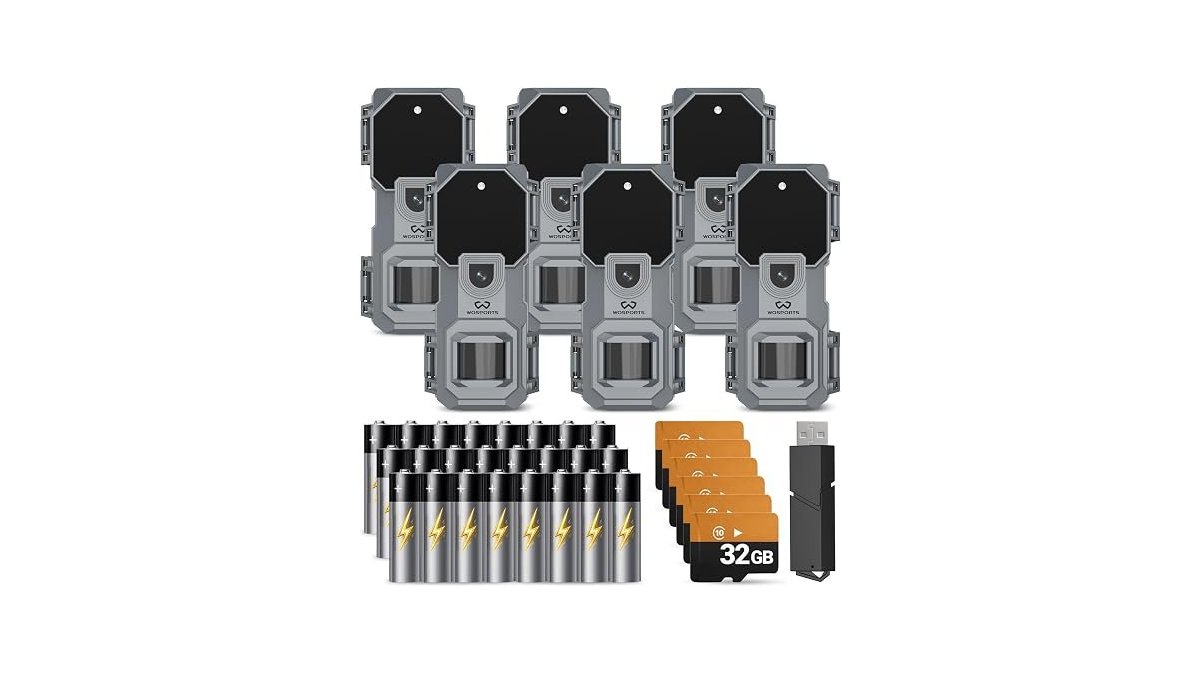
The WOSPORTS Mini Trail Camera comes as a 6-pack, which is ideal if you need to monitor several spots on a large property simultaneously. Each unit includes a 32GB SD card and a card reader, so you have everything required to start recording right away. These cameras are waterproof for outdoor monitoring.
Because they run on 4 AA batteries and consume low power in standby, you won’t need to check on them as often as other models. If you’re monitoring crops or property, place these units to capture motion-activated triggers that prevent pests or intruders from damaging your facilities.
However, this model isn’t for someone who requires advanced cellular alerts or 4K video resolution, as it’s designed for standard 1080P monitoring. Always read the manual before deployment to ensure you understand the specific motion-activation settings. The manufacturer provides online customer support for setup guidance.
Pros
- Six cameras in one pack.
- Includes 32GB memory cards.
- Waterproof for heavy rain.
Cons
- Resolution is limited to 1080P.
- No cellular connectivity features.
2. WOSPORTS Rechargeable Trail Camera(Non-Cellular Non-WiFi) 2Pack 56MP 4K Game Cam

Best for: High-resolution image capture.
This 2-pack offers 56MP photo resolution and 4K video, providing sharp detail for those who need to identify small features on wildlife or property. It features a 120-degree wide-angle lens and a 0.2-second trigger speed, ensuring that movement is captured quickly across a wide field of view. The built-in 2-inch LCD screen allows you to review footage directly on the device.
The rechargeable lithium battery system is designed for extended use, but you must remove the battery to charge it separately. The camera’s Type-C port is for data transfer only; attempting to charge through this port will fail. If you require a “set and forget” system that never requires physical battery handling, this model will frustrate your workflow.
Because it lacks cellular or Wi-Fi connectivity, all footage remains on the local SD card. This ensures your data stays private and immune to remote hacking, but it requires you to physically visit the camera to retrieve your files.
Pros
- High 56MP photo resolution.
- Fast 0.2-second trigger speed.
- Built-in 2-inch LCD screen.
Cons
- Must remove battery to charge.
- No internet or cellular connectivity.
3. MUDDY Merge 3-Pack Cellular Trail Cameras

Best for: Remote property surveillance.
The MUDDY Merge Cellular system is designed for those who want to see images and videos without physically traveling to the camera. It uses the COMMAND app to send data directly to your mobile device, which is helpful for monitoring remote areas or sensitive hunting zones. With a 0.4-second trigger speed and burst mode, it’s built to capture fast-moving targets accurately.
Choose the Verizon option if your property has coverage from that carrier, or select the AT&T variant to ensure signal availability in your specific region. You can verify your local service map before purchasing to avoid connectivity gaps.
The system captures high-resolution 26-megapixel images, though you can adjust these to 4MP, 8MP, or 16MP to save storage space. If you need to track specific species, use the app to tag animals or humans within the frame. This tagging feature simplifies sorting through large volumes of media.
The system supports Verizon and AT&T, allowing you to choose the best signal for your location. This isn’t for buyers who prefer to keep their data purely local or who don’t want to manage a mobile connection plan.
Pros
- Remote cellular app access.
- Fast 0.4-second trigger speed.
- Dual-SIM mobile connection options.
Cons
- Requires active mobile service plan.
- Not for offline data storage.
4. 3 Pack Trail Cameras

Best for: Nighttime wildlife activity.
These cameras by WOSODA use 940nm infrared light, which provides night vision that doesn’t frighten animals away. The 48MP resolution and 4K video capabilities offer high-quality playback on the integrated 2-inch LCD screen. With a 120-degree wide-angle sensor and 80-foot detection range, these cameras cover a large area effectively.
The 0.2-second trigger speed means you’re unlikely to miss quick movement in the frame. If you notice too many empty files, adjust the settings to reduce inadvertent shots caused by swaying grass or leaves. This saves both power and memory card storage space.
This product isn’t for users who need long-range cellular notifications, as it’s a standard non-cellular camera system. Use the password protection feature if you’re placing these in public areas to secure your data.
Pros
- No-glow infrared night vision.
- Wide 120-degree detection angle.
- Includes 16GB memory cards.
Cons
- No remote mobile app support.
5. Trail Camera 2 Pack 4K 64MP Solar Game Camera

Best for: Long-term, low-maintenance monitoring.
The FRKTCAM solar trail camera features a built-in 5000mAh battery paired with a top-mounted solar panel to minimize the need for manual battery replacements. It captures 64MP photos and 4K video, offering some of the highest resolution in this group. The IP67 waterproof rating provides strong protection against the elements, making it a rugged choice for year-round field use.
The included 64GB memory card offers plenty of space for high-resolution files. If you’re monitoring a high-traffic area, use the custom monitoring period feature to save storage space and battery life.
This camera isn’t for buyers who prefer a compact, lightweight unit, as the solar panel integration adds to the overall size of the device.
Pros
- Integrated solar power charging.
- High 64MP photo resolution.
- Strong IP67 waterproof rating.
Cons
- Larger size due to panel.
- Requires precise mounting for solar exposure.
6. GardePro E5S 2-Pack Non-Cellular Trail Camera

Best for: Reliable non-cellular operation.
The GardePro E5S uses three PIR sensors to achieve a 0.1-second trigger speed, which is excellent for capturing fast-moving wildlife. It supports 64MP photos and 1296P video, providing a balance between high detail and manageable file sizes. The non-cellular, non-WiFi design ensures privacy and keeps power consumption low.
If you require continuous, maintenance-free monitoring in remote locations, connect the GardePro SP350 solar panel to the unit. Without this solar addition, you must monitor your battery levels closely, as the device relies on eight AA batteries.
Choose Motion Detection if you want to save space, or use Hybrid Mode to capture both time-lapse sequences and motion-triggered events. This camera isn’t for users who want immediate alerts on their phone, as all data must be retrieved manually from the SD card.
Pros
- Extremely fast 0.1s trigger.
- Supports up to 512GB storage.
- Low power consumption design.
Cons
- No cellular or remote alerts.
7. Browning Command Ops Elite 40MP Trail Camera 2-Pack Bundle

Best for: Professional-grade clarity.
The Browning Command Ops Elite is a 40MP camera bundle that includes everything needed for high-quality scouting. It uses Illuma-Smart night vision to adjust the infrared flash, keeping nighttime photos balanced and clear up to 80 feet. The 0.3-second trigger speed provides a quick response for capturing movement accurately.
If you’re scouting large properties, use the cameras in this bundle to cover multiple distinct game trails simultaneously. This dual-location approach maximizes your odds of tracking movement patterns.
The bundle comes with a card reader and cleaning cloth, which shows attention to the needs of a serious user. The included microfiber cloth is for keeping the equipment clean.
This camera isn’t for someone who wants the latest cellular connectivity features, as it focuses on traditional high-performance local recording. If you require real-time alerts on your phone, choose a cellular model instead.
Pros
- High 40MP image resolution.
- Advanced adjustable IR flash.
- Includes SD card reader.
Cons
- Lacks cellular mobile connectivity.
Also worth considering: The Moultrie Edge Cellular Trail Camera offers a balance of cellular convenience with a 0.5s trigger. The Muddy Pro Cam Trail Cameras are a solid 4-pack option for basic, high-quantity setups. Finally, the MUDDY Mitigator Cellular Trail Camera provides another cellular option with 36MP resolution for those focused on remote hunting surveillance.
How to Choose in Sixty Seconds
Which connectivity type is best for me?
Choose cellular if you need to monitor property without frequent trips to the site. Cellular cameras send images to an app, saving time and preventing human scent from spooking wildlife. However, they require a cellular subscription and a stable signal. If you prefer total privacy or operate in an area with poor reception, non-cellular models are more reliable. Check the IP-rating to ensure the camera fits your local weather conditions.
Does resolution actually matter for my needs?
For basic property surveillance, 16MP to 26MP is usually enough to identify objects or animals. If you’re tracking specific wildlife patterns or need to zoom in on details like antler growth, 40MP to 64MP is better. Remember that higher resolution creates larger file sizes, which fills your SD card faster. If you choose a high-resolution camera, ensure your SD card has enough capacity to handle the storage requirements. A 32GB card is standard for many sets, but opt for 64GB if you plan on high-frequency 4K video recording.
What should I look for in a trigger speed?
Trigger speed is the time between the camera detecting motion and taking the photo. A speed of 0.2 to 0.4 seconds is ideal for capturing fast-moving animals on a trail. If the speed is too slow, you might find empty frames or only the tail end of an animal. Always prioritize models with a faster trigger speed if your primary goal is wildlife photography. If you’re monitoring a stationary area like a feeder or a gate, the trigger speed is less critical than the camera’s detection range, which can reach up to 80 or 100 feet.
Frequently Asked Questions
Do these cameras work in complete darkness?
Yes, all these cameras use infrared (IR) technology to capture images at night. Most models use “no-glow” or “low-glow” IR LEDs to record activity without spooking animals with a bright flash. Be aware that night vision performance typically drops off beyond 80 feet, depending on the specific model’s IR array.
What happens when the SD card gets full?
Most modern trail cameras include a “loop recording” function. When this is enabled, the camera automatically overwrites the oldest files on the SD card to make room for new ones. This is essential for long-term monitoring where you can’t visit the site to clear the card frequently. If your camera doesn’t feature loop recording, you must manually format or clear the SD card once it reaches capacity, or recording will stop.
Are these cameras difficult to set up?
Setup is generally straightforward, though it varies by type. Non-cellular models are “plug and play,” requiring only batteries, an SD card, and manual settings. Cellular models, such as the MUDDY Merge, require an extra step of downloading an app and syncing the device to your mobile network.
Which model is best for a beginner?
The WOSPORTS Mini Trail Camera is excellent for beginners because the pack includes cameras, SD cards, and a card reader. It provides a simple way to start monitoring multiple locations at once without needing separate accessories. Note that this model lacks advanced features like cellular connectivity or 4K video.


