
Selecting a video camera battery charger depends on how many batteries you need to maintain and whether you are shooting in a studio or on the move. The main differences lie in how many slots are available, how fast they charge, and if they support specific power delivery standards for your gear.
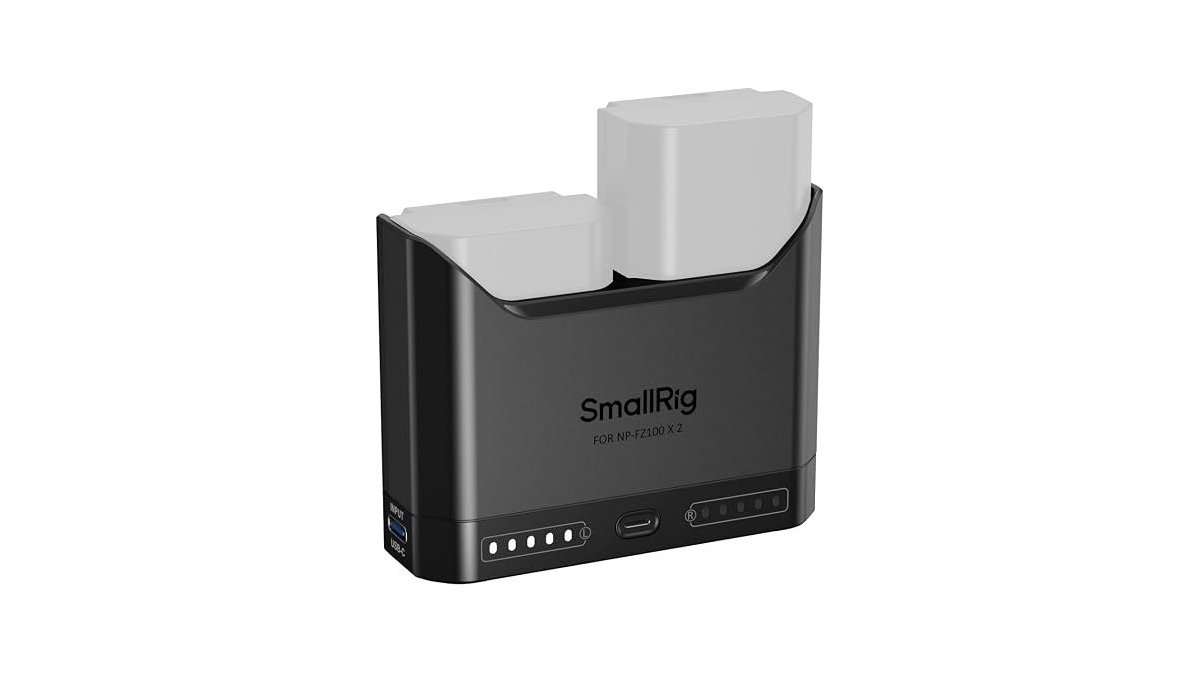
Best overall: SmallRig NP-FZ100 Charger offers rapid two-hour dual-slot charging and an intuitive LED display, making it a reliable, high-performance choice for most Sony camera users.
Best for multiple batteries: Neewer 3-Slot NP-FZ100 Charger allows you to charge three batteries simultaneously in two hours, while also providing convenient storage for your extra memory cards.
Best for heavy-duty production: Neewer 4-Channel NPF Charger uses 100W PD technology to power four large batteries at once, perfect for long video shoots requiring constant, reliable power.
This guide is for photographers and videographers who need efficient, safe power solutions for their camera batteries.
How We Picked
We compared 16 different battery charger listings to find the most capable options for various camera systems. To earn a place, each product had to clearly state its charging speed, compatible battery types, and safety features like over-voltage or over-temperature protection. Products that lacked clear technical specifications or failed to offer distinct advantages in channel count or power delivery were excluded from our final selection.
1. SMALLRIG NP-FZ100 Battery Charger

Best for: Sony Alpha users needing quick, dual-battery charging.
This charger features a dual-slot design that recharges two NP-FZ100 batteries in about 2 hours. It uses a 22.5W USB-C input, which means you can power it with wall adapters, car chargers, or portable power banks. The built-in LED indicators show the charge level for each battery, which helps you track power even when the unit isn’t plugged in.
Always pair this device with a power adapter rated for 22.5W or higher. If you use a 5V/2.4A adapter, the charger prioritizes the battery in Channel 1 first, automatically switching to Channel 2 once the first is fully charged. Avoid using 5V/1A adapters entirely, as they aren’t compatible.
The charger includes smart safety features like over-temperature and over-voltage protection. If the unit gets too hot, it slows down charging to keep your batteries safe. As the batteries near full capacity, the system automatically switches to trickle charging to preserve long-term battery health. This model isn’t for users who need to charge more than two batteries at once, as the dual-slot design is strictly limited to that capacity.
Pros
- Rapid dual-slot charging speed
- Clear LED battery level display
- Compact and portable design
Cons
- Limited to two batteries
- Requires 22.5W power adapter for full speed
2. NEEWER BASICS 3 Slot USB Battery Charger

Best for: Creators who need extra storage for memory cards.
This unit charges three NP-FZ100 batteries at the same time in two hours when using a 36W PD power source. It’s part of a basic line focused on essential functions without extra bells and whistles. A unique feature is the inclusion of five memory card slots, which hold two SD, two TF, and one CFexpress Type A card to keep your gear organized.
If you’re using a standard wall block, ensure it meets the 36W threshold. Using a lower-wattage power source will significantly increase the time required to reach a full charge. The listing doesn’t mention the effect of using an adapter under 36W.
The charger connects via USB-C, allowing you to use it with laptops or portable power banks. It includes a standard protection system to prevent overcharging and short circuits. This charger isn’t for those who don’t use Sony batteries, as the slots are specifically shaped for the NP-FZ100 type. If you use third-party batteries, verify their dimensions against the original 16.4Wh NP-FZ100 specifications to ensure a proper fit.
Pros
- Charges three batteries simultaneously
- Built-in memory card storage
- Versatile USB-C power input
Cons
- 36W adapter not included
- Large footprint for travel
3. NEEWER 4 Channel NPF Battery Charger

Best for: Videographers using high-capacity NP-F series batteries.
This 4-channel charger is built for heavy-duty use, supporting four NP-F batteries at once. When used with the included 100W PD GaN wall charger, it can fully recharge four 10500mAh NP-F970 batteries in 4.5 hours, or four 7800mAh units in 3 hours. The OLED display provides real-time data on voltage, current, and temperature for every channel, giving you total control over the process.
The unit features a built-in fan that turns on automatically if temperatures exceed 122°F to keep everything cool. It also includes an undervoltage activation function to revive batteries that have gone into sleep mode. If your battery fails to register on the display, this feature restores full performance by waking the internal cells.
You can select output levels of 8.4V/0.9A, 8.4V/1.8A, or 8.4V/2.5A. If you’re unsure which to pick, the built-in current detection switch automatically adjusts the output to ensure optimal efficiency. This charger isn’t for those looking for a pocket-sized device, as its 4-channel capacity and cooling system make it a larger, studio-focused tool.
The included 100W GaN charger is a versatile addition. Beyond the NP-F dock, you can use it to power your laptop, smartphone, or even V-mount batteries like the PS099E, which charges in 1.5 hours.
Pros
- Charges four batteries simultaneously
- Detailed OLED status display
- Includes 100W GaN charger
Cons
- Larger size for portability
- Requires high-wattage power source
4. NEEWER 4 Channel USB Camera Battery Charger

Best for: Canon shooters managing multiple LP-E6 batteries.
Designed for Canon users, this charger handles four batteries at the same time using PD 45W fast charging. It’s compatible with various versions of the LP-E6 battery, including the LP-E6N, LP-E6NH, and LP-E6P.
The device only functions when the input voltage is correct, which you can verify by checking the five indicator lights on the front panel; the unit is ready to charge only when these lights glow green. If the lights remain dark, check your power source immediately.
This model is a vital solution for long vlogging or portrait sessions where you can’t afford to stop shooting. Because it’s powered via USB-C, you can connect it to car chargers or portable power banks to keep your gear topped up in the field.
Avoid using a 20W charger or anything below the 45W threshold. If you attempt to use a low-power adapter, the unit won’t initiate the charging cycle. Furthermore, this charger doesn’t support 5V or 9V inputs. Always pair it with a dedicated PD 45W source to ensure you reach a full charge for four 2400mAh batteries in just 3 hours.
Pros
- Charges four Canon batteries at once
- Compatible with multiple LP-E6 types
- Convenient USB-C power input
Cons
- Requires 45W PD charger
- Not compatible with 5V/9V inputs
5. Sony BC-TRW W Series Battery Charger

Best for: Photographers who prefer original manufacturer equipment.
This compact charger is designed by Sony specifically for the W series batteries. It features a retractable plug, which makes it very easy to pack in a small camera bag for travel. The universal voltage support allows you to use it in different countries without worrying about power compatibility. Because it accepts 100V-240V at 50/60Hz, you can plug it into any standard wall outlet worldwide.
It’s a dedicated single-slot charger that focuses on reliability and simplicity. Because it’s a manufacturer-standard product, it maintains a consistent, straightforward design. This charger isn’t for those who need to charge multiple batteries at once, as it only handles one unit at a time. If you own three or more spare batteries, this single-slot limitation will force you to manage a rotating charging schedule throughout your day.
Using this Sony-branded unit ensures your NP-FW50 battery receives the exact voltage and current profile intended by the manufacturer. If you value battery longevity over rapid, multi-battery throughput, this is the correct choice.
Pros
- Retractable plug for travel
- Universal voltage compatibility
- Reliable manufacturer-standard build
Cons
- Charges only one battery
- Slow compared to multi-slot options
6. SmallRig NP-FW50 4-Channel Camera Battery Charger

Best for: Sony mirrorless users with multiple older batteries.
This multi-slot charger acts as a central hub for the NP-FW50 battery. It supports 24W PD input to charge four 1030mAh batteries in a rapid timeframe. The unit is highly intelligent, detecting your power source to determine how many channels to activate.
If you provide 5V/1A, the charger activates one channel. Using 5V/2A starts two channels, while 9V enables three. To charge all four batteries simultaneously, you must provide 12V to 15V. If your input adapter lacks sufficient power, the charger defaults to a sequential mode, prioritizing the battery with the highest charge level first. For optimal performance, always use a USB-C charger with an output of 27W or higher.
The unit weighs only 3.7 ounces and measures 3.1 x 3.1 x 1.2 inches. This portability makes it ideal for mobile creators. Each port features independent short-circuit and overcurrent protection to safeguard your gear. Note that this device is exclusively for the NP-FW50 battery, fitting models like the A6000, ZV-E10, and A7 series. It won’t work with larger battery types.
Pros
- Charges four batteries simultaneously
- Smart power source detection
- Very light and portable
Cons
- Requires 27W adapter for peak speed
- Exclusively for NP-FW50 batteries
7. Bower Universal Battery Charger

Best for: Users with a variety of camera and household batteries.
This universal charger uses adjustable clamps and sliding tabs to fit many different types of lithium-ion batteries. It’s designed to handle both 3.7V and 7.4V packs, as well as NiMH AA and AAA batteries. The inclusion of a USB output also means you can charge your phone or other small devices while the battery is in the cradle.
You should opt for this model if you own multiple cameras from different brands and want to avoid carrying a separate charger for each. It’s particularly useful for consolidating your gear into one 5.04W power output station. However, don’t expect rapid, simultaneous multi-battery charging. This unit prioritizes broad compatibility over high-speed throughput.
If you’re currently juggling a bag full of proprietary chargers, this device will simplify your kit. Conversely, if you’re a professional photographer who requires back-to-back charging for back-up batteries during a shoot, the manual clamp adjustment will likely be too slow for your workflow.
Pros
- Fits many battery shapes
- Charges AA and AAA batteries
- Includes extra USB port
Cons
- Not designed for speed
- Manual clamp adjustment needed
How to Choose in Sixty Seconds
Does the number of charging slots really matter?
The capacity of the charger dictates your workflow rhythm. If you shoot video for hours, a multi-slot charger like the Neewer NW-P4 or the SmallRig NP-FW50 unit prevents the constant interruption of swapping batteries. For those with only two batteries, a dual-slot charger like the SmallRig NP-FZ100 is significantly more portable.
If you choose a multi-channel unit, verify the power requirements. Some chargers, like the SmallRig NP-FW50, intelligently scale their output based on the adapter. If you provide 5V/1A, it charges one battery; at 12V-15V, it activates all four. Using an insufficient adapter forces the charger to prioritize slots sequentially, which negates the benefit of having multiple channels.
Should I prioritize fast charging or portability?
Fast charging is a function of the power adapter, not just the charger. To hit the two-hour mark for charging three NP-FZ100 batteries, you must use a 36W PD power adapter. The Neewer LP-E6 charger will not work when charged with a 20W charger or below.
Always match the adapter wattage to the charger’s minimum threshold. If you use a 5V/2.4A adapter with the SmallRig NP-FZ100 charger, it defaults to a slow-charge mode, filling Channel 1 before starting Channel 2. If you’re mobile, a USB-C input is essential, as it allows you to pull power from car chargers or portable power banks. If you need to stay light, the Sony BC-TRW offers a retractable plug, but it lacks the multi-battery efficiency of the newer USB-C hubs.
Is it safe to use third-party chargers?
Safety depends on the integrated protection protocols. Look for chargers that explicitly state over-voltage, over-current, and over-temperature protection. Advanced units, like the Neewer NW-F4, include internal fans that activate when temperatures exceed 122°F.
Check for an undervoltage activation function if you frequently leave batteries in storage; this feature can reactivate cells that have fallen into sleep mode. Avoid chargers that don’t specify these safety steps, as they can’t properly manage the trickle-charging phase that preserves battery health near full capacity.
Related guides


