
Choosing the right trail camera depends on whether you need remote access via cellular networks or prefer a simple, local-storage setup. The biggest differences lie in how you retrieve your images, how the battery is managed, and whether the device requires a monthly data plan for live viewing.
Best overall: GardePro E8PMB WiFi, which combines reliable local WiFi access with a long-lasting internal battery and pre-loaded memory for immediate, easy setup in the field. Best for cellular access: GardePro X66 Pro, which offers advanced GPS tracking and live-view capabilities, making it the top choice for users who need remote monitoring updates. Best for simple needs: WOSPORTS Rechargeable Camera, which provides a straightforward, no-fuss experience for those who want private, local storage without any internet or app connectivity.
The rest of this guide is for hunters, property owners, and wildlife enthusiasts looking for the most efficient power management solutions.
How We Picked
We compared 48 different trail camera listings to find models that prioritize rechargeable battery technology over traditional, disposable AA cells. To earn a spot, each listing had to clearly state its battery capacity, its charging method, and the specific wireless or storage features included. We excluded any models that relied solely on external power sources or lacked clear, manufacturer-provided specifications for their internal battery performance.
1. GardePro E8PMB WiFi Trail Camera

Best for: Property owners needing quick, close-range video access.
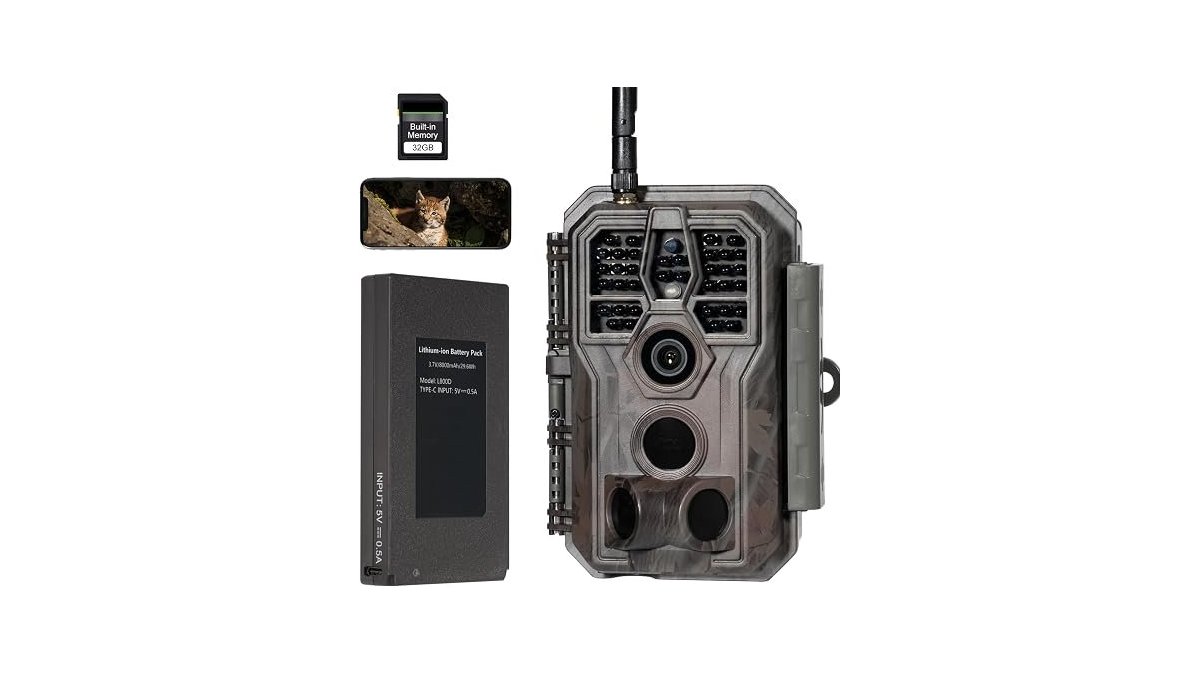
The GardePro E8PMB WiFi stands out by including 32GB of pre-loaded memory, meaning you can start monitoring your land immediately without buying extra accessories. Its low-power WiFi and Bluetooth allow you to check the camera’s position or download files directly to your phone from up to 45 feet away. This is perfect for setup, as you can see exactly what the camera sees without taking it down.
The built-in 8000mAh battery is designed to last up to a year, assuming standard usage of 20 daytime and 20 nighttime photos daily. This saves significant time on maintenance. If you have a high-traffic area, you can add a solar panel to keep the system running without ever needing to remove it for a charge. Use the SP300 for light activity or the SP1000 for higher usage scenarios.
This model isn’t for users who need to check their camera from hundreds of miles away. It connects only to your smartphone via local signals, meaning it won’t link to home WiFi routers, laptops, or web browsers. If you can’t physically stand within 45 feet of the device, you’ll be unable to access the live view or download your files.
Pros
- Includes 32GB memory card
- Long-lasting 8000mAh battery
- Convenient local WiFi access
Cons
- No home network connection
- Limited to phone range
2. Meidase P300 Pro (Non-Cellular) WiFi Trail Camera

Best for: Capturing fast-moving wildlife with precision.
The Meidase P300 Pro features a dual-antenna system that extends your wireless connection range to 165 feet in open areas. If you’re placing the camera in dense woods or near metal structures, expect that range to drop significantly. The 0.1s trigger speed is built to catch quick action without missing the shot. It arrives with a 64GB industrial SD card, ensuring you have reliable storage right out of the box.
The 2.4-inch color screen makes it easy to change settings or review footage while standing in the field. Because it uses Bluetooth and WiFi for direct app control, you can manage the camera without pulling the SD card. However, this device isn’t suitable for those who want automatic cloud updates. It requires you to be within range of the unit to pull your files.
If you need year-long performance, the 7800mAh battery handles roughly 15 daytime and 15 nighttime photos daily. If your site sees higher activity, add a Meidase solar panel to keep the unit running. Remember that this camera only supports direct smartphone connections. It won’t connect to home routers, cellular networks, or computers.
Pros
- Fast 0.1s trigger speed
- Wide 165ft WiFi range
- 64GB SD card included
Cons
- No cellular data support
- Signal blocked by walls
3. GardePro X66 Pro Cellular Trail Camera

Best for: Remote monitoring of large properties.
The GardePro X66 Pro is a cellular model that sends images and videos directly to your phone, provided you have an active data plan. It includes built-in GPS, which helps you keep track of your camera’s location if it’s moved or placed in a large, unfamiliar area. You can even share access with friends or family, making it a great choice for collaborative land management.
The 7800mAh battery pack is both rechargeable and replaceable. You can swap in a fresh pack for longer trips without needing a solar panel immediately. If you choose the Instant mode, expect up to two months of operation based on 15 daytime and 15 nighttime photos per day. For true year-round performance, pair the unit with an SP300 or SP1000 solar panel.
This camera requires a data plan for the live-view and cloud-upload features to function. If you manage multiple units, you can pool your HD photos, videos, and live-view usage under a single account.
Pros
- Built-in GPS tracking
- Remote cellular live view
- Replaceable battery pack
Cons
- Requires data plan subscription
- Higher maintenance for cellular
4. Rechargeable Trail Camera
Best for: Users who prioritize data privacy.
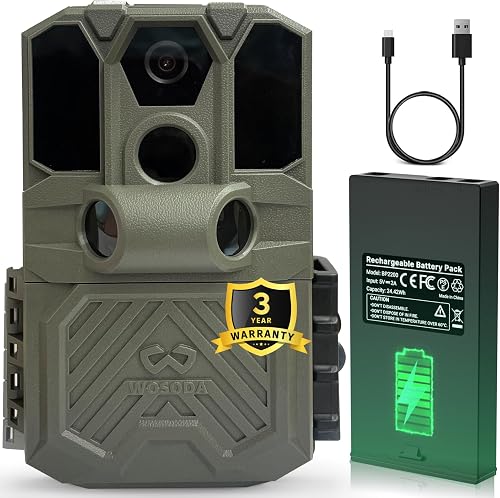
The WOSPORTS Rechargeable Trail Camera is built for simplicity, offering a completely offline experience that keeps all your files on a local SD card. Because it never connects to the internet, there’s no need to worry about cloud accounts or remote access breaches. It features a 2-inch LCD screen for easy menu navigation and quick playback of your 40MP photos.
The 2200mAh battery is built-in, though you must remove it to charge it separately. Never attempt to charge the unit via the Type-C port, as this can damage the internal components. This maintenance step is vital for longevity. If you need to monitor property from a smartphone, look elsewhere; this model lacks wireless connectivity or app support.
Use the 120° detection angle and 0.2s trigger speed to capture wildlife up to 80ft away. If you find the camera triggering too often, adjust the PIR settings to reduce false captures and preserve your battery life.
Pros
- No internet or cloud
- 2-inch color display
- Simple menu system
Cons
- Must remove battery to charge
- No remote wireless access
5. Solar Trail Camera WiFi Bluetooth -5K 60MP Game Camera

Best for: Long-term, set-it-and-forget-it monitoring.
The LANTOOCAM Solar Trail Camera uses a top-mounted solar panel to keep its 5200mAh battery topped off, making it ideal for locations you visit only once or twice a year. If you face a long stretch of cloudy weather, you can add 8 AA batteries to ensure the camera keeps recording for up to 30 days without interruption. It’s designed to handle temperatures between 14°F and 113°F, making it a rugged choice for harsh environments like deserts or snowy forests.
The 5K video resolution and 60MP photo capability provide high detail for those who need to identify specific wildlife features. If you’re placing the unit in a public area or near children, use the password protection feature to prevent others from tampering with your settings. This camera isn’t for users who prefer a minimalist setup, as the solar panel and extra battery slots make the unit bulkier than standard models.
Pros
- Integrated solar panel
- High 5K video resolution
- Dual-power flexibility
- Password security
Cons
- Bulkier design profile
- 8 AA batteries not included
- Requires SD card formatting
6. Moultrie Edge Solar Cellular Trail Camera

Best for: Hunters who want AI-assisted identification.
The Moultrie Edge Solar stands out by using AI to detect wildlife, which filters your alerts so you only see what matters most. It connects automatically to the strongest of four major networks, meaning you don’t have to worry about SIM cards or manual carrier setup. The integrated solar panel keeps the internal battery charged throughout the season.
If your property has dense canopy cover, adjust the panel angle to maximize sun exposure. This ensures the battery remains topped off even in challenging light.
The Easy Aim mount allows you to see the camera’s view on your phone while you’re mounting it, ensuring perfect placement every time. This model isn’t for someone who wants to avoid subscription fees, as it relies on cellular service and cloud storage plans to deliver its features. If you hunt in remote areas, trust the 100-foot detection range and 0.4-second trigger to capture movement without blur.
Pros
- No SIM card setup
- Continuous solar power
Cons
- Subscription fees required
- Cellular coverage dependent
7. WOSPORTS Rechargeable Trail Camera(Non-Cellular Non-WiFi) 2Pack 56MP 4K Game Cam

Best for: Multi-area surveillance.
The WOSPORTS Rechargeable Camera comes in a multi-unit bundle, which is perfect if you need to cover multiple points on a farm or property. Like other offline models, it stores everything on an SD card and avoids the privacy risks of internet-connected cameras. It captures sharp 56MP photos and 4K video, providing high-quality images for detailed scouting.
The 0.2s trigger speed is fast enough for most wildlife tracking needs, and the 120-degree wide-angle lens captures a large area with a single device. This isn’t for users who want to be alerted instantly when movement is detected, as it doesn’t have cellular or WiFi push notifications.
To maintain your battery, always remove the lithium unit to charge it separately. Never attempt to charge through the Type-C port, as that connection is strictly for data transfer.
If you need to save storage space, adjust your burst shooting mode or increase the shot delay. These settings help prevent the camera from recording redundant footage of the same subject. Use the 2-inch LCD screen to verify your framing on-site, which avoids the mistake of leaving the camera pointed at empty brush.
Pros
- Convenient multi-unit value
- High 4K video quality
- Wide detection angle
Cons
- No remote notifications
- Manual file retrieval
How to Choose in Sixty Seconds
Does cellular connectivity matter for my needs?
If you want to view photos instantly without visiting the site, cellular is the only way to go. However, these models require a monthly data plan. If you’re monitoring a backyard or a property you visit weekly, a WiFi or non-wireless camera is better. WiFi models let you download photos when you’re nearby, while non-wireless models require you to pull the SD card.
What battery configuration is most reliable?
Integrated solar panels are the most reliable for long-term, unattended monitoring. They keep the battery charged during the day, reducing the need to visit the site. If you choose a model with a built-in rechargeable battery, ensure you have a plan for charging it, as some require you to remove the battery pack entirely. Models that allow for backup AA batteries provide an extra layer of security during long periods of low sunlight or harsh winter conditions.
Is resolution the most important factor?
Higher resolution numbers like 56MP or 60MP sound impressive, but they often result in larger file sizes that fill up your SD card faster. For general wildlife tracking, 24MP to 40MP is usually plenty of detail. Focus more on the trigger speed and the detection angle. A fast trigger speed ensures you catch the animal before it leaves the frame, while a wide detection angle ensures the camera wakes up early enough to record the movement.
Related guides
Frequently Asked Questions
What happens if the weather is cloudy for weeks?
Solar-powered models like the LANTOOCAM or Moultrie Edge Solar handle standard weather fluctuations. Some units, such as the LANTOOCAM, allow you to insert backup AA batteries as a fail-safe. If your camera lacks a solar panel, ensure it is fully charged before deployment.
Do I need to buy extra parts to get started?
Most kits include the camera and a charging cable, though some models like the GardePro E8PMB WiFi and Meidase P300 Pro include internal memory. Many other models require a separate SD card. Always check the listing to confirm if a card is included.
What is the first thing that usually breaks?
The most common point of failure on any trail camera is the battery compartment or weather-sealing gaskets. Models like the WOSPORTS and Meidase P300 Pro feature IP66-rated housing to prevent moisture damage. Always inspect the rubber seals for debris every time you open the unit.
Is a simpler, non-wireless camera enough?
A non-wireless camera is often more than enough if you’re tracking wildlife in your own backyard or on a local plot of land. Non-wireless models do not rely on cellular networks or WiFi pairing. If you don’t need instant alerts or remote access, the WOSPORTS or the WOSPORTS Rechargeable Camera bundle can handle the job perfectly while keeping your data private and local.


