
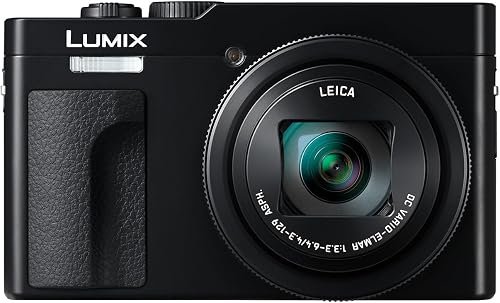
The Panasonic LUMIX ZS99 is the best travel camera for beginners who want a do-it-all powerhouse, while the Canon EOS R100 is the clear choice for those preferring a dedicated system for learning photography. Choosing the right camera depends on matching your travel habits to features like zoom range, portability, and sensor size.
1. Panasonic LUMIX TZ/ZS99 Point and Shoot Camera

Best for: Someone who wants a high-zoom camera that fits in pockets.
The ZS99 is built for travelers who need one camera to handle everything from wide city streets to far-off details. Its 30x zoom lens provides a massive 24-720mm range, meaning you can capture a sweeping landscape and then zoom in on a distant building without changing gear. This makes it a strong contender for those who find changing lenses stressful or simply too bulky while moving between locations.
This camera includes a tiltable touchscreen, which helps when shooting from low angles or taking self-portraits. Because it uses USB Type-C for charging, you can keep it powered up using the same cables you likely carry for your phone. It isn’t for the person who wants to swap lenses for different artistic effects, as the lens is permanently attached to the body.
Good if:
- You want a long zoom range in a compact body.
- You prefer charging your camera via USB Type-C.
- You need a screen that tilts for varied shooting angles.
Skip it if:
- You’re looking to experiment with interchangeable lenses.
- You want the largest possible sensor for professional-style background blur.
2. Sony ZV-1F Compact Digital Camera 4K Video Black

Best for: Travelers who plan to record daily vlogs and selfies.
The ZV-1F is designed with the content creator in mind, featuring an ultra-wide 20mm lens that captures more of your surroundings when you hold the camera at arm’s length. It uses a 1-inch sensor, which helps with performance in dim conditions and allows for that soft background look that makes subjects pop. The side-articulating screen is specifically meant for you to see yourself while recording, ensuring you’re always centered in the frame.
The built-in directional 3-capsule microphone is a key feature here, as it aims to capture clear voice audio without needing extra equipment. If you aren’t interested in vlogging or recording your own travel clips, you might find that other models offer more versatility for pure photography.
Good if:
- You prioritize vlogging and selfie-style video capture.
- You want a wide field of view for tight spaces.
- You value a dedicated microphone for clearer audio.
Skip it if:
- You don’t care about recording video of yourself.
- You need a long zoom lens to reach distant subjects.
3. Panasonic LUMIX ZS300S Compact Travel Camera

Best for: Travelers who demand high image quality in a small package.
The ZS300S features a 20.1MP 1-inch sensor, which is larger than the sensors in many standard travel cameras. This size allows it to pull in more light, leading to better detail in your photos, especially when the sun goes down. The 15x optical zoom is a balanced middle ground, giving you plenty of reach for travel sites without making the camera too heavy to carry all day.
This model is a great fit for someone who wants to step up their image quality without sacrificing the convenience of a pocketable device. It includes macro focus capabilities, allowing you to get as close as 1.18 inches to your subject. It isn’t for the user who needs the massive zoom range of the ZS99, as the 15x zoom is more limited by comparison.
Good if:
- You want a 1-inch sensor for better low-light performance.
- You need a versatile zoom range for most travel scenarios.
- You enjoy capturing close-up macro shots.
Skip it if:
- You need to zoom in on very distant wildlife or architecture.
- You want the most basic, entry-level interface available.
4. KODAK PIXPRO FZ55 16MP Compact Digital Camera

Best for: The first-time buyer who wants simple, straightforward operation.
The FZ55 is a no-nonsense camera that focuses on basic functionality. With its 16MP sensor and 5x optical zoom, it provides a simple way to take photos without navigating through complex menus or settings. It’s lightweight and easy to manage, making it a reliable backup or a first camera for someone who just wants to point and shoot.
The camera charges its battery internally via USB, which keeps your packing list short. Because it’s a basic model, it lacks the advanced stabilization and high-speed burst features found in models with larger sensors.
Good if:
- You want a very simple, easy-to-use interface.
- You prefer a lightweight camera for casual snapshots.
- You need a camera that charges via a standard USB cable.
Skip it if:
- You need advanced autofocus or image stabilization.
- You want to shoot high-quality 4K video.
5. 7X Optical Zoom Digital Camera

Best for: Beginners who want a complete kit with plenty of accessories.
This camera from LeuLix stands out because it arrives as a total package, including a 32GB memory card and two batteries. Its 5-axis anti-shake technology is designed to keep your shots steady, which is helpful if you’re prone to shaky hands or shooting while walking. The 7x optical zoom provides a decent reach for scenery, while the touchscreen makes navigating settings feel familiar.
The camera can also function as a webcam, which is a nice touch if you plan on doing live streams or video calls from your hotel room. The listing doesn’t mention the brand’s history or optical design.
Good if:
- You want a bundle that includes all necessary accessories.
- You need extra batteries for long days of shooting.
- You want stable video footage for your travel clips.
Skip it if:
- You prefer established camera brands with large lens ecosystems.
- You’re looking for professional-grade image processing.
6. 8K Digital Camera

Best for: Beginners who want high-resolution video options and a flip screen.
The ULPTXOO camera focuses on high numbers, offering 8K video and 88MP photo capabilities to help you capture every detail. The 3-inch flip screen is a great help for framing your own shots, especially when you’re traveling solo and need to set up a quick portrait. Its autofocus system is designed to lock onto subjects quickly, which is helpful for busy tourist spots.
The camera comes with two batteries and a charger, so you can swap out power sources mid-day. It’s a solid choice for someone who wants to experiment with different creative modes, like time-lapse or slow motion.
Good if:
- You want a flip screen for easy selfies and vlogging.
- You like having multiple batteries included in the box.
- You want to try creative modes like time-lapse.
Skip it if:
- You’re worried about large file sizes filling up memory.
- You need a brand with extensive global service support.
7. Canon EOS R100 Mirrorless Camera with RF-S 18-45mm Lens Bundle

Best for: Someone ready to start a serious photography hobby.
The Canon EOS R100 is a true mirrorless camera, which means it uses a large APS-C sensor and allows you to change lenses. The included 18-45mm lens is a great starting point for general travel, offering a sharp, versatile range. Because it uses Canon’s Dual Pixel CMOS AF, it’s much faster and more accurate at tracking faces and subjects than the point-and-shoot options listed here.
This camera is for the traveler who wants to learn the fundamentals of photography, such as aperture and shutter speed.
Good if:
- You want to learn photography with interchangeable lenses.
- You need fast, professional-grade autofocus tracking.
- You prefer the feel and control of a dedicated mirrorless body.
Skip it if:
- You need a camera that fits into a small pocket.
- You want to avoid the extra weight of a larger system.
Where These Overlap
Most of these cameras share a few common traits. Almost every model here includes Wi-Fi or Bluetooth, allowing you to move photos to your phone quickly. This is essential for modern travel, where you want to share images with friends or family while you’re still on the go. Additionally, the move to USB charging across the board is a welcome change, as it means you can leave bulky proprietary wall chargers at home.
However, the line is drawn clearly between fixed-lens cameras and the Canon EOS R100. If you want simplicity and size-savings, the Panasonic ZS99 and the ZS300S are very close in their ease of use, even if the ZS300S offers better image quality from its larger sensor. The other models, like the Kodak FZ55 and the LeuLix 7X, are for those who want a simple tool that just works without requiring a deep dive into camera settings.
Still Not Sure?
How often will I really use it?
If you only take photos once or twice a year, a simple camera like the Kodak PIXPRO FZ55 is enough to document your trip without the hassle of a complex system. If you plan to shoot every day, the Panasonic LUMIX ZS99 offers the zoom range needed to keep things interesting. Buying more camera than you need often leads to leaving it in the hotel safe.
What do I already own that this has to work with?
Think about your current workflow. If you rely on your smartphone to edit and share images, you should pick a model with a robust app, like the Panasonic LUMIX ZS300S. If you already have a collection of Canon lenses, the Canon EOS R100 is the logical path. Ensuring the camera fits your existing digital life prevents the frustration of clunky file transfers.
What am I most likely to regret choosing?
The most common regret is buying a camera that’s too heavy to carry. If you find the Canon EOS R100 too bulky, you’ll likely leave it in your room. If you buy a tiny point-and-shoot but miss the control of a real lens, you might regret not choosing the Sony ZV-1F or the EOS R100. Always check the physical size versus your travel style.
Related guides
Frequently Asked Questions
Which travel camera is best for beginners?
For a beginner, the 8K Digital Camera is often the easiest starting point because it includes a complete kit of batteries, a memory card, and a screen that flips for easy self-portraits. It simplifies the setup process by providing everything you need in one box. For those who want to learn professional photography skills, the Canon EOS R100 is the better choice for long-term growth.
Do I need a camera with an interchangeable lens?
You only need an interchangeable lens system if you want to experiment with different focal lengths or specialized optics for portraits and landscapes. The Canon EOS R100 allows you to upgrade your lens as your skills improve. If you prefer to keep your travel bag light, the Panasonic LUMIX ZS99 or ZS300S provides a huge range of zoom without the need to carry extra glass.
Is image stabilization really important for travel?
Yes, image stabilization is vital because you often shoot while tired, walking, or in low-light environments where you can’t use a tripod. The 7X Optical Zoom Camera uses 5-axis anti-shake technology to keep your handheld shots clear.
Does the sensor size make a big difference?
A larger sensor, like the 1-inch sensor in the Panasonic LUMIX ZS300S or the APS-C sensor in the Canon EOS R100, captures significantly more light than the sensors in basic point-and-shoot cameras. This results in sharper photos with less digital noise when shooting in dim restaurants or at sunset. If you prioritize image quality over raw zoom power, always look for the largest sensor available.


