
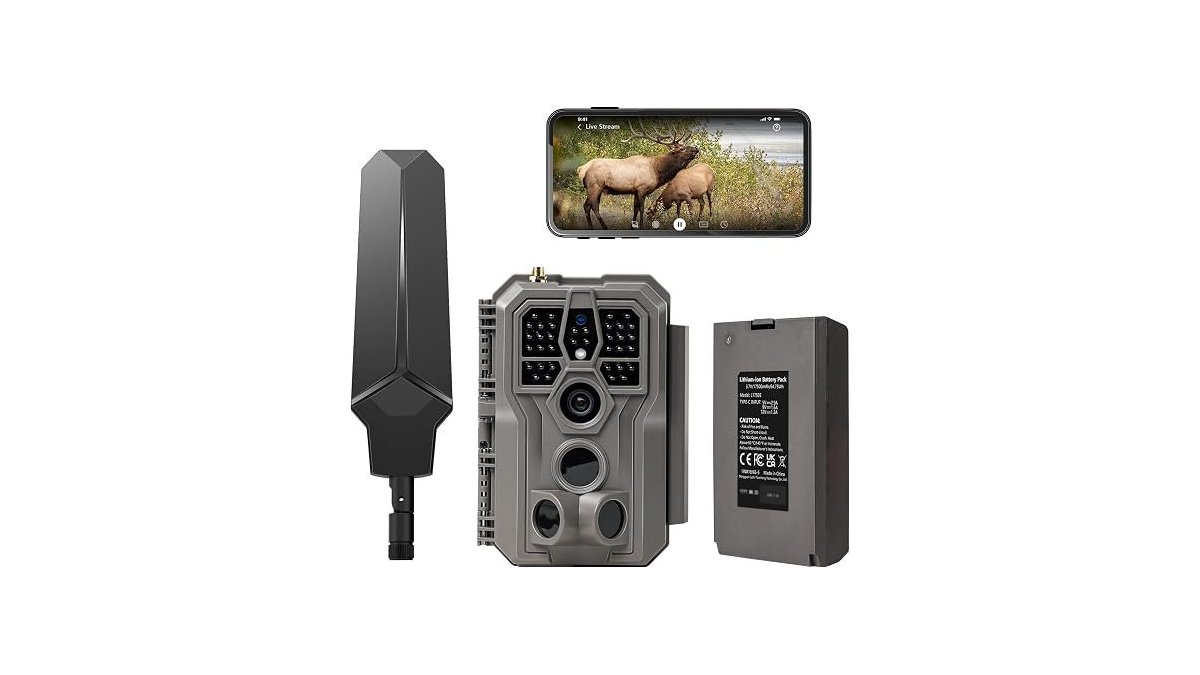
When choosing the best trail camera with longest battery life, battery capacity and power management are the deciding factors for long-term field use. While many cameras offer high-resolution imaging, the most successful models minimize the need for manual maintenance through large internal batteries or integrated solar panels. The GardePro X66 3.0 leads the category by pairing a massive 17,500mAh battery with smart power-saving detection modes. By focusing on how these devices handle energy, you can ensure your equipment remains active for an entire season without requiring frequent site visits.
Head to Head on What Matters
Best Trail Camera Battery Life
The battery capacity dictates your maintenance schedule. The GardePro X66 3.0 leads with a 17,500mAh pack, designed to survive an entire season even in active modes. The GardePro E8PMB offers an 8,000mAh battery, lasting up to one year under moderate use. The MAXDONE Solar Trail camera provides 6,000mAh.
If you choose a model with a smaller battery, you must use a solar panel to avoid frequent manual swaps. Note that the WOSODA requires you to remove the battery to charge it separately; never attempt to charge it through the camera’s Type-C port. For maximum longevity, pair the GardePro X66 3.0 or E8PMB with dedicated solar panels. SPYPOINT’s Flex-S Dark uses an integrated solar panel to extend its internal battery life up to 11 months, making it a strong choice if you can’t visit the site often.
Detection and Trigger Speed
Trigger speed is the difference between a clear shot and an empty frame. The GardePro X66 3.0, E8PMB, and A3S offer the fastest response at 0.1s. The WOSODA follows at 0.2s, while the Moultrie Edge Solar triggers at 0.4s.
If your camera faces a high-traffic trail where animals move quickly, prioritize the 0.1s trigger models to prevent missed shots. While a 0.4s speed is sufficient for slow-moving subjects at bait sites, it may result in motion blur on faster paths.
Storage and Connectivity
Cellular models like the GardePro X66 3.0, Moultrie Edge Solar, and SPYPOINT Flex-S Dark offer remote access but require subscription plans. If you need real-time alerts, these are your only options.
For local storage, the GardePro E8PMB and MAXDONE include pre-installed memory, saving you an immediate purchase. The GardePro A3S supports up to 512GB of external storage, ideal for high-volume 64MP photo or 1296p video recording. If you choose a non-cellular WiFi model like the E8PMB or MAXDONE, remember they create a local hotspot; they don’t connect to your home network. Use these only if you can physically walk within 10 to 55 feet of the camera to download your files.
What the Numbers Mean for You
When choosing a camera, battery capacity is the most critical spec for reducing maintenance. A larger battery, like the 17,500mAh pack in the GardePro X66 3.0, allows the camera to stay active for an entire season without manual swaps. However, capacity doesn’t replace the need for efficient power management. If you plan to use features like live view or frequent video uploads, a massive battery is a necessity, not a luxury.
If you can’t visit your site frequently, prioritize models with integrated solar panels or the largest available internal battery to avoid gaps in your monitoring. Be aware that some cameras, such as the WOSODA model, require you to remove the battery to charge it separately; failing to note this means you must physically retrieve the camera, which defeats the purpose of a long-term setup.
Always check if the camera supports solar expansion. For example, the GardePro E8PMB supports external panels to maintain its 8000mAh battery for up to a year. If you choose a non-cellular model, you can rely on lower power consumption, but you’ll lose the ability to receive instant alerts.
1. GardePro X66 3.0 Ultra 4K Cellular Trail Camera
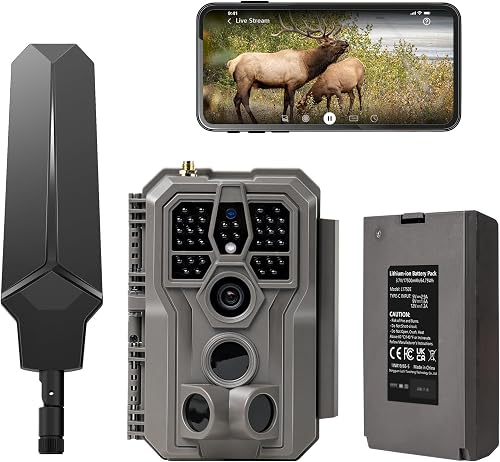
The GardePro X66 3.0 is built for users who prioritize extreme endurance and high-resolution monitoring, featuring a high-capacity battery pack designed to sustain an entire season of activity—defined as 15 daytime and 15 nighttime photos per day—without requiring a battery swap. Its 17,500mAh lithium battery pack is the standout feature, designed to sustain an entire season of activity—defined as 15 daytime and 15 nighttime photos per day—without requiring a battery swap.
If you need year-round performance, pair this unit with a GardePro SP300 or SP1000 solar panel. This setup prevents the common mistake of relying solely on internal power during high-traffic periods, which can drain even large batteries prematurely.
The camera uses dual-core technology to process data locally. This means the device continues to monitor movement and capture new events even while it’s busy uploading previous shots. You avoid the gap in coverage that plagues many other cellular models.
This camera isn’t for those seeking a simple, standalone device. It requires an active cellular data plan to utilize its core features, including Live View, remote GPS tracking, and On-Demand HD requests. If you manage multiple units, you can pool your HD photo and video allowances under a single shared account to manage your data usage.
Best for: Long-term cellular monitoring with heavy activity.
Pros
- Massive rechargeable battery built for long-term field deployment.
- 0.1s trigger speed for fast action.
- On-device Edge AI wildlife recognition.
Cons
- Requires a cellular data plan.
2. Moultrie Edge Solar Cellular Trail Camera

The Moultrie Edge Solar focuses on convenience through its integrated solar panel. By eliminating the need for AA batteries entirely, it provides a “set and forget” experience for remote properties. The adjustable panel angle allows you to maximize sun exposure regardless of your tree orientation.
The camera automatically connects to the strongest of four major U.S. networks, removing the need for manual SIM card setup. If you’re hunting in an area with spotty coverage, the camera’s ability to switch carriers ensures more reliable delivery than single-network devices.
This camera is built to push all content to the cloud, so you never need to visit the site to retrieve an SD card. Use the Moultrie App to request on-demand video or update settings from your phone. If you prioritize local storage or offline access, this cloud-first system won’t meet your needs.
Best for: Maintenance-free operation in sunny, remote locations.
Pros
- Integrated solar panel for continuous power.
- Nationwide 4-carrier auto-connect.
Cons
- Entirely dependent on cloud storage.
3. MAXDONE Solar Trail Camera

The MAXDONE Solar Trail camera is a practical choice for those seeking solar power without monthly cellular subscriptions. Its split solar panel design allows you to angle the panel toward the sun independently of the camera lens, maximizing charging efficiency regardless of the terrain.
This unit isn’t for users who require real-time alerts or push notifications. It doesn’t support home Wi-Fi, cellular, 4G, or 5G networks. Instead, the camera creates its own short-range hotspot for setup and file downloads. You must be within 33–50 feet in open areas to connect. If you need remote monitoring from another city, this model won’t meet your needs.
The camera includes a 6000mAh battery and a pre-installed 32GB SD card. It captures 4K video and 64MP images, with a 0.1-second trigger speed for fast-moving animals. Night vision reaches up to 65 feet without disturbing wildlife.
Best for: Backyard, farm, or forest monitoring where you can visit the device to download files.
Pros
- Flexible split solar panel design.
- No monthly subscription fees.
- Includes 32GB SD card.
Cons
- No cellular or home Wi-Fi support.
- No real-time alerts.
- Requires proximity for app connection.
4. SPYPOINT Flex-S Dark Starter

The SPYPOINT Flex-S Dark is built for stealth, featuring no-glow LEDs that remain invisible to animals at night. The built-in solar panel keeps the internal battery charged for up to 11 months, which is ideal for hunters who want to avoid disturbing their hunting grounds.
You can switch between no-glow and low-glow settings remotely. Use no-glow when total invisibility is required to avoid spooking game. If you need a stronger flash reach, switch to the low-glow setting. This camera isn’t for users who want to avoid app-based management, as the SPYPOINT app is central to its operation.
Many users fail to pair the device with the LIT-22 rechargeable lithium battery pack. Doing so provides a critical backup, ensuring the camera stays powered through long periods of low sunlight. If you hunt in dense canopy or during short winter days, this addition prevents unexpected power loss.
Best for: Discreet night monitoring in remote areas.
Pros
- No-glow LEDs for total invisibility.
- Up to 11 months of battery life.
- Free 100-photo monthly plan.
Cons
- Requires app-based setup and monitoring.
5. GardePro E8PMB WiFi Trail Camera

The GardePro E8PMB is a reliable Wi-Fi camera that keeps your data local while offering the convenience of a smartphone app. With an 8,000mAh battery, it can last up to a year on a single charge based on 20 daytime and 20 nighttime photos daily.
It’s an excellent choice for property surveillance where you can periodically walk within range to download images. This model isn’t for those who need to access their camera from a remote location, as the Wi-Fi range is limited to 45 feet. Don’t attempt to connect this device to your home router or a laptop; it communicates exclusively with the GardePro Mobile App via a direct Bluetooth and Wi-Fi handshake.
If you anticipate high-traffic areas, choose the SP1000 solar panel to maintain power indefinitely. For minimal traffic, the SP300 is sufficient. Users often mistake the range for standard home Wi-Fi; if you can’t stand within 45 feet of the unit, you’ll be unable to retrieve your footage.
Best for: Local Wi-Fi monitoring with high-capacity battery.
Pros
- Built-in rechargeable battery for reliable, cord-free power.
- Pre-installed 32GB memory.
- 0.1s trigger speed.
Cons
- Limited to short-range Wi-Fi connection.
- No cellular or home network support.
6. Rechargeable Trail Camera
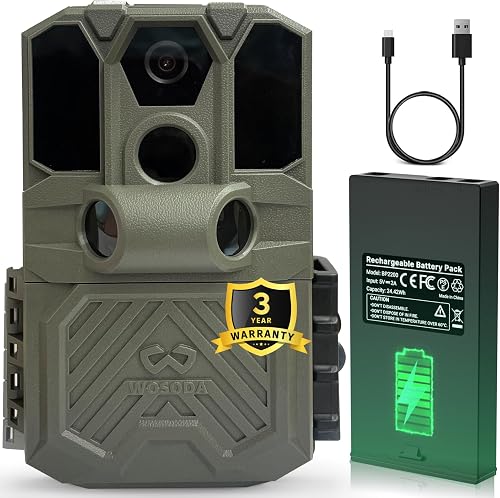
The WOSODA Rechargeable Trail Camera prioritizes local security by avoiding internet connectivity entirely. Because it never connects to Wi-Fi or cellular networks, your footage stays in your hands, safe from cloud breaches or remote access.
You must remove the 2200mAh lithium battery to charge it separately. Don’t attempt to charge the unit through the Type-C port, as this won’t power the device. If you need to keep the camera active for long periods, consider keeping a spare battery ready to swap in while the other charges.
This device is ideal for users who demand privacy and reliable, motion-activated performance. The listing doesn’t mention the trigger speed or detection range. You can customize settings like Shot Lag, Time-Lapse, and Target Recording Time to fit your specific scouting needs.
Best for: Secure, private monitoring with no internet access.
Pros
- 100% local storage ensures privacy.
- 0.2s fast trigger speed.
- 2-inch color LCD display for playback.
Cons
- Battery must be removed to charge.
- No remote access or cloud syncing.
7. GardePro A3S Non-Cellular Trail Camera

The GardePro A3S is built for performance in environments where cellular or Wi-Fi signals are unavailable. It uses a high-quality Sony Starvis sensor to provide excellent low-light performance, making it ideal for deep-woods wildlife tracking. This camera isn’t for those who want a built-in rechargeable battery, as it requires 8 AA batteries for operation, though it does support solar panel add-ons.
If you need to capture fast-moving subjects, the 0.1s trigger speed and 120° detection angle ensure you rarely miss a frame. Use the 5-shot burst mode to increase your odds of catching a clear image of quick wildlife.
Many users mistake the lack of cellular connectivity for a lack of sophistication. In reality, this design choice minimizes power drain and eliminates the need for monthly data subscriptions. If you’re monitoring a remote area for months, prioritize the solar panel add-on to avoid frequent site visits.
Best for: High-resolution, non-cellular wildlife tracking.
Pros
- Sony Starvis sensor for low-light clarity.
- Supports up to 512GB SD cards.
- 0.1s trigger speed.
Cons
- Requires 8 AA batteries.
Related guides
Frequently Asked Questions
Is a bigger battery capacity always better?
A larger battery capacity typically means the camera can run longer between charges, which is ideal for remote monitoring. However, actual longevity depends on your settings, such as how many photos or videos you capture daily. A camera with a smaller battery can still be efficient if it has a low-power standby mode or an integrated solar panel.
What does an unlisted battery life spec mean?
If a manufacturer doesn’t provide a specific duration for battery life, it’s often because usage patterns vary too widely to provide an accurate estimate. Factors like temperature, the number of triggers, and the use of night vision infrared LEDs significantly impact power consumption. Always look for the mAh rating instead, as it provides a concrete measure of the total energy storage.
How do I compare two different power units?
To compare different power systems, look for the mAh rating for internal batteries or the solar panel’s ability to provide continuous power. If one camera uses AA batteries and another is rechargeable, consider how often you’re willing to visit the site. Rechargeable units with solar options generally offer the most convenience for long-term placement in the field.
Does a higher trigger speed matter?
A faster trigger speed is essential if you want to capture fast-moving animals without blur or missed shots. A 0.1s trigger speed is very responsive, ensuring the camera starts recording the moment motion is detected. If you’re monitoring a slow-moving area like a feeder, a slightly slower trigger speed may still be effective for your needs.


