
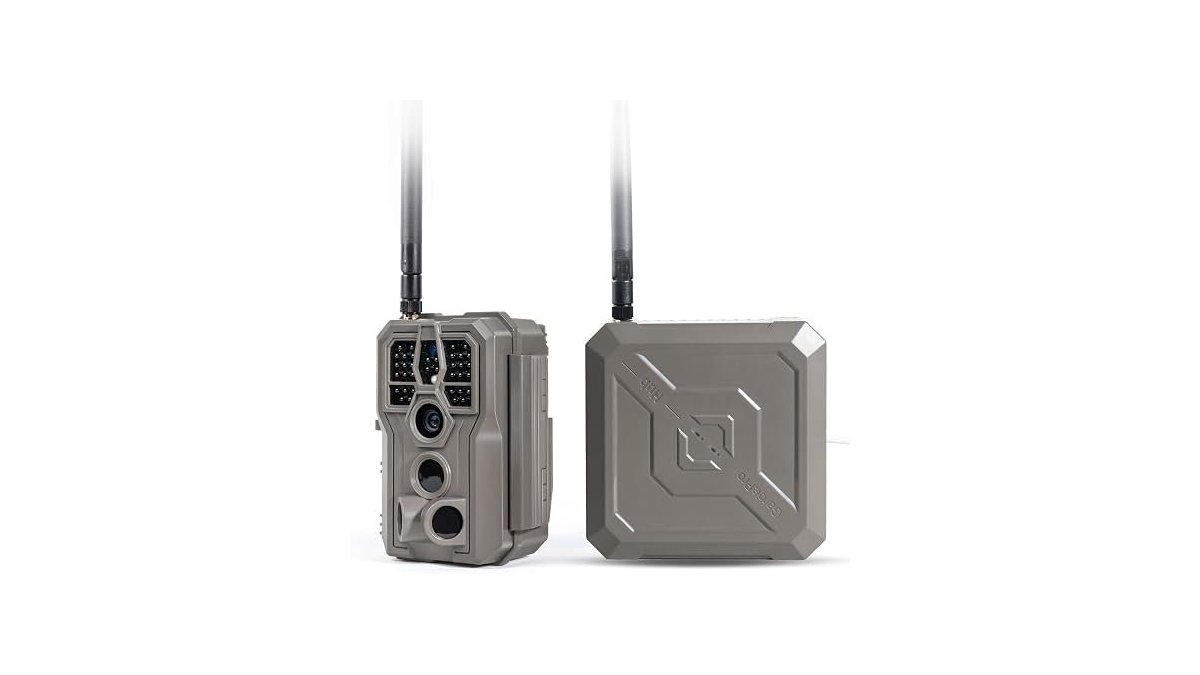
Finding the best trail camera with longest detection range depends on your property layout and your need for convenience. While many cameras offer similar resolutions, the real difference lies in how they transmit data and how far they detect motion. The GardePro Link 1.0 leads for long-range wireless setups, while the SPYPOINT FORCE-4K and kejector Wildlife Camera offer different approaches to field monitoring. We evaluate these based on detection range, connectivity, and power efficiency to help you choose the right tool for your specific environment.
Head to Head on What Matters
Detection Range
The detection range defines the boundary where the PIR sensor wakes the camera. If you’re monitoring a wide-open field, prioritize the SPYPOINT FORCE-4K with its 110-foot reach. For tighter areas like game trails or narrow forest paths, a 45-foot range—like that of the kejector Wildlife Camera—is often superior; it prevents the camera from triggering on distant movement that would result in empty frames. The GardePro Link 1.0, Meidase P70, and Browning Recon Force Elite sit in the middle at 100 feet, offering a balance for general property surveillance.
Connectivity and Data Transfer
If you prefer to avoid signal dependency, the kejector Wildlife Camera and Meidase P70 rely on manual SD card retrieval.
Trigger Speed
Trigger speed is the time elapsed between motion detection and the first shutter release. A 0.1s speed, found on the GardePro A3S and Meidase P70, is the gold standard for capturing fast-moving animals crossing directly in front of the lens. If your target is a slow-moving herd, the 0.4s speed of the SPYPOINT FORCE-4K or the sub-half-second performance of the Tactacam REVEAL X 3.0 is sufficient. Avoid the mistake of ignoring the trigger speed for high-traffic areas; a slow trigger often results in images of only the rear half of an animal as it exits the frame.
What the Numbers Mean for You
When choosing a camera, the detection range is the most critical factor for success. A camera with a 110-foot range, like the SPYPOINT FORCE-4K, covers more ground than a 45-foot unit, which is helpful for open fields. However, a wider detection angle, such as the 120° field found on the kejector Wildlife Camera, helps catch animals moving along the edges of your view.
Higher megapixel counts provide more detail for identification, but they also result in larger file sizes. If you can’t visit your site often, consider a cellular or long-range wireless model to save time. For instance, the GardePro Link system allows you to monitor up to 16 cameras from a single hub, covering distances up to 1600 feet in typical use.
If you choose a non-cellular model, you must rely on physical SD card retrieval. In this case, prioritize models with H.264 compression, like the Meidase P70, which creates smaller, more manageable video files for faster playback.
Always match your power strategy to your visit frequency. If you can only check your site occasionally, opt for cameras compatible with solar panels or those with high-capacity battery life, such as the Tactacam REVEAL X 3.0, which can run for over six months. Proper IP66 waterproof standards ensure your equipment survives heavy rain and dust in outdoor environments.
1. GardePro Link 1.0 Long Range WiFi Trail Camera

The GardePro Link 1.0 is built for users who need to monitor large areas without constant manual checks. Its Hub-based system allows for a wireless connection up to 1,600 feet, which is significantly farther than standard WiFi cameras. This makes it ideal for large ranches or farms where you need to link up to 16 cameras to one central point.
If you have an open field, you can push that range to 3,000 feet. However, if your property has dense trees or buildings, expect a significantly reduced range. Always place the Hub near your home WiFi router to ensure the signal remains stable across all connected devices.
The system relies on a 7,800mAh battery. If you need year-round operation, pair the unit with a GardePro SP350 or SP1000 solar panel. Without a solar add-on, you’ll need to manually recharge the battery periodically.
Best for: Large property owners needing centralized wireless coverage.
Pros
- 1,600 ft typical wireless range.
- Includes 64GB industrial-grade SD card.
- 4K UHD video resolution.
- Free plus cloud plan included.
Cons
- Requires Hub setup for connectivity.
- Relies on external power for year-round use.
2. SPYPOINT FORCE-4K Trail Camera

The SPYPOINT FORCE-4K focuses on providing a wide field of view and high-resolution imaging. With a 66° field of view and 110-foot detection range, it’s designed to minimize blind spots while hunting or tracking game.
The inclusion of a two-inch color screen allows for quick, on-site setup and review. You should use this screen to verify your framing immediately after mounting the camera to ensure you’re capturing the intended trail path.
This camera isn’t for users who require remote access or cellular alerts, as this is a strictly non-cellular, SD-card-based device. If you need real-time data sent to your phone, this model won’t meet your needs. Instead, it’s built for those who prefer to manually retrieve their files and process high-definition data at home.
You’ll find the most success using this unit during dusk and dawn. The camera is tuned to capture color images during these transition periods, which provides the critical context needed to pattern wildlife behavior.
Best for: Hunters wanting a wider field of view for scouting.
Pros
- 110 ft motion detection range.
- 66° field of view.
- 48MP photo resolution.
- Integrated 2-inch LCD screen.
Cons
- No remote wireless connectivity.
- Requires manual SD card retrieval.
3. kejector Wildlife Trail Camera

The kejector Wildlife Camera offers a 120° detection range, useful for capturing movement across a broader area. It uses an F/1.6 aperture lens to gather light, which helps with night vision clarity. The 0.2s trigger speed is fast enough for most wildlife activity. It isn’t for users who need long-range wireless data transmission, as it’s a non-WiFi device.
If you’re monitoring a narrow trail, the 45-foot detection range is sufficient. However, if you’re tracking fast-moving animals in open fields, place the camera at an angle to the path to maximize the 120° field of view. This ensures the PIR sensor registers motion before the animal crosses the entire frame.
Avoid mixing old and new batteries when using the 4 or 8 AA configuration. Failing to do this can cause the camera to shut down prematurely during night recording.
Best for: Monitoring wide paths where animals move quickly.
Pros
- 120° wide detection range.
- 0.2s trigger speed.
- Supports up to 512GB SD cards.
- F/1.6 large-aperture lens.
Cons
- 45 ft IR sensing range is shorter than competitors.
- No wireless connectivity.
4. GardePro A3S Non-Cellular Trail Camera

The GardePro A3S is a reliable, non-cellular camera featuring a Sony Starvis sensor for high-quality low-light images. Its 0.1s trigger speed ensures that fast-moving wildlife are captured quickly. It’s designed for those who prefer a simple, set-and-forget system that records to an SD card.
It avoids the battery drain of wireless radios, meaning you spend less time maintaining the device.
The camera supports 512GB SD cards for extensive storage. Use the loop recording setting if you want the camera to overwrite older files automatically when the card fills up. For remote locations, pair the unit with the GardePro SP350 solar panel to avoid frequent battery changes.
Best for: Reliable, high-quality images in low light.
Pros
- 0.1s fast trigger speed.
- 64MP photo resolution.
- Sony Starvis sensor for low light.
- Supports 512GB SD cards.
Cons
- No wireless or cellular capabilities.
- Batteries not included.
5. Tactacam REVEAL X 3.0 Cellular Trail Camera

The Tactacam REVEAL X 3.0 uses an integrated SIM to automatically lock onto the stronger signal between AT&T and Verizon. This eliminates manual SIM swapping and prevents dead zones common with single-network devices. If you’re in an area with zero cellular coverage, this unit won’t transmit data; it’s strictly for properties with active LTE signals.
Setup takes under 10 minutes by scanning a QR code in the REVEAL app. Because the antenna and SIM are pre-installed, you avoid the common mistake of damaging delicate internal pins or misconfiguring network settings during initial deployment.
The camera features a sub-half-second trigger speed paired with a 3-shot burst mode. This ensures you capture fast-moving game before it clears the frame, a significant upgrade over single-shot models that often miss the target.
You can extend the 6-month battery life by pairing the unit with a solar panel or lithium cartridge for year-round, hands-off monitoring. While it functions as a trail camera, its real value lies in acting as a property monitoring system for gates and equipment. It stores photos internally, removing the need to buy or format separate SD cards.
6. Meidase P70

The Meidase P70 is a high-performance, non-cellular camera built for stealth and image clarity. Its 940nm no-glow LEDs ensure the device remains invisible to wildlife at night, while the f/1.6 aperture lens captures sharp 64MP photos and 1296p video.
The 0.1s trigger speed is essential for capturing fast-moving deer. Side sensors detect motion instantly, ensuring you never miss a moment.
Because it lacks cellular or Wi-Fi connectivity, this camera isn’t for users who require remote access to their footage. You must manually retrieve the SD card or use the 2.4-inch color display to review files on-site.
To avoid power interruptions during long deployments, pair the unit with a Meidase SP350 solar panel. If you rely solely on the internal tray, you must provide your own set of eight AA batteries. H.264 video compression keeps files small for faster playback on your devices.
Best for: Discreet monitoring where stealth is a priority.
Pros
- 0.1s trigger speed.
- 100ft no-glow night vision.
- H.264 video compression.
- 2.4-inch color display.
Cons
- No cellular or wireless features.
- Batteries sold separately.
7. Browning Trail Cameras Recon Force Elite HP5 Ultra (Non-Cellular)

The Browning Recon Force Elite prioritizes raw imaging power, capturing 46MP photos and 1440p Full HD video with sound. Its Radiant 5 IR flash illuminates subjects up to 100 feet away, making it a reliable choice for monitoring deep woods where cellular signals fail.
If you need to verify camera placement immediately, use the built-in 2-inch color display to preview footage on-site. This saves you from pulling an SD card only to find your framing was off.
The camera supports SDXC cards up to 512GB, which is essential for continuous recording in time-lapse mode. If you’re tracking high-traffic trails, enable the SD card management feature to overwrite older files automatically.
This model isn’t for users who require instant remote alerts or off-site monitoring. If you rely on real-time notifications, this non-cellular unit will disappoint.
Best for: High-resolution photo and video clarity.
Pros
- 1440p Full HD video.
- Adjustable 100 ft detection range.
- Supports 512GB SD cards.
- Built-in 2-inch color display.
Cons
- No cellular or wireless data transfer.
- Larger footprint compared to some compact models.
Related guides
Frequently Asked Questions
Is a longer detection range always better?
A longer detection range is better if you’re monitoring large, open areas like fields or long trails. However, in dense forests, a very long range can lead to false triggers from movement outside your target area. It’s important to match the detection range to the size of the area you need to watch.
What does an unlisted detection range mean?
If a manufacturer doesn’t list a specific detection range, it usually means the sensor’s performance varies based on ambient temperature and the size of the animal. You should look for models that explicitly state their range to ensure the camera fits your specific site requirements and avoids disappointment in the field.
How do I compare two different detection units?
Manufacturers may list detection ranges in feet or meters. To compare them, convert all figures into the same unit, such as feet. Always check if the range is defined as “maximum” or “typical,” as real-world results depend on environmental factors like brush, sunlight, and the heat signature of the wildlife passing by the sensor.
Does a faster trigger speed matter?
A faster trigger speed is essential if you place your camera on a fast-moving game trail. A camera with a 0.1s trigger is more likely to capture the center of a fast animal than one with a 0.7s trigger. If you’re monitoring a stationary feeder, a slightly slower trigger speed will likely perform just as well.


