
Finding the best trail camera for beginners depends on what you value most: simple hands-off operation or deep control over your images. Beginners often struggle with complex menu systems or the need to manage SD cards manually, so the main split is between those who want a “set it and forget it” unit and those who prefer a cellular model that sends photos directly to a phone. The WOSPORTS Trail Camera and the Tactacam REVEAL X 3.0 lead these two different approaches for most new users.
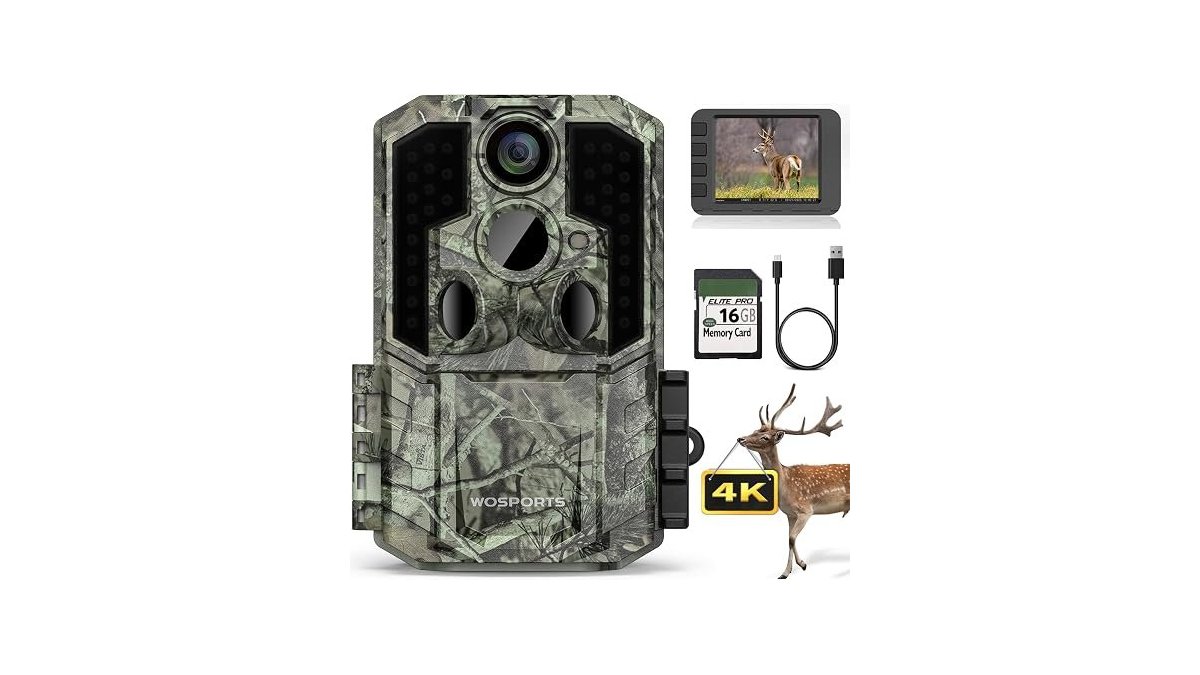
1. WOSPORTS Trail Camera(Non-Cellular Non-WiFi) 64MP 4K 0.2S Trigger Motion Activated

Best for: Someone who wants a high-resolution camera for general backyard monitoring.
This model is designed for users who want to capture detailed images without needing complicated technical skills. Its 64MP photo capability allows for sharp images, while the 2-inch LCD screen lets you review footage right on the device. Because it uses an SD card for storage, you’ll need to physically retrieve the card to view your files on a computer or reader.
The 0.2-second trigger speed is built to catch fast movement, which is helpful for deer scouting or tracking pets in a yard. It uses no-glow infrared LEDs to avoid spooking animals at night. If you’re looking for a device that works independently of cellular networks, this unit provides a straightforward experience.
Good if:
- You prefer viewing photos on a built-in screen.
- You want high-resolution 64MP still images.
- You need a device that doesn’t require a data plan.
Skip it if:
- You’re unable to visit the camera location to swap SD cards.
- You want an automated way to receive images on your phone.
2. WOSPORTS Mini Trail Camera

Best for: A user who needs a discreet, lightweight camera for easy transport.
This mini version is built for those who prioritize concealment and portability. Its smaller frame makes it easier to hide in dense foliage or on small posts where a larger camera might stand out. Despite its size, it captures 30MP photos and 1080P video, covering the basics for wildlife or garden monitoring.
The setup process is simple, relying on a standard mounting strap. Because it uses 4 AA batteries, it’s lighter to carry into the woods than models requiring 8 batteries. It’s a solid choice for a first-time buyer who wants to experiment with trail cameras without a large or heavy device.
Good if:
- You need a camera that’s easy to hide.
- You prefer a lighter unit for hiking to remote locations.
- You’re a first-time user who wants a simple setup.
Skip it if:
- You need the highest possible resolution for your photos.
- You require the longest possible battery life between changes.
3. Meidase P70 Trail Camera

Best for: Someone who wants the best image detail and fast processing.
The Meidase P70 focuses on image quality through a high-performance f/1.6 aperture lens and H.264 video compression. This compression technology makes your files smaller, meaning you can store more footage on your SD card and download it faster. The 0.1-second trigger speed is designed to capture animals moving quickly through the frame.
Side sensors detect motion instantly to support that trigger speed. If you’re monitoring a narrow game trail, the side sensors might trigger too often; in that case, adjust the sensitivity settings to prevent empty shots.
With a 2.4-inch display, it offers one of the larger screens for on-the-spot playback. This is helpful if you’re out in the field and want to verify your camera angle or focus immediately. For long-term deployment, pair it with the SP350 solar panel. If you rely solely on the eight AA batteries, check the power levels every two weeks to avoid gaps in your data. It’s a strong choice for someone who is serious about getting clear, sharp images of wildlife.
Good if:
- You want the fastest trigger speed for quick wildlife.
- You prefer smaller file sizes for easier viewing.
- You want a larger screen for checking footage.
Skip it if:
- You find advanced menu settings overwhelming.
- You don’t need the highest resolution for casual observation.
4. GardePro E5S Non-Cellular Trail Camera

Best for: A beginner who wants a rugged, no-nonsense camera.
The GardePro E5S is built for durability and efficient power use. It uses three sensors to trigger the camera in 0.1 seconds, which is designed to minimize the chance of missing a subject. Because it lacks cellular or Wi-Fi features, it consumes less power, meaning you won’t need to change the batteries as often as with more complex units.
If you’re placing the camera in a remote area, use the 1/4″-20 mounting thread to secure it to a tree or post. To avoid frequent battery swaps, connect the GardePro SP350 solar panel for continuous power. If you notice your images are blurry, check that the lens is clear of debris, as the high-quality optical sensor is sensitive to obstructions.
Good if:
- You want a simple, reliable device that survives tough weather.
- You prefer a camera that doesn’t need frequent battery changes.
- You need a fast trigger speed for fast-moving game.
Skip it if:
- You want to change camera settings remotely.
- You need a built-in solar solution included in the box.
5. CEYOMUR 4K 68MP Solar WiFi Trail Camera

Best for: Someone who wants to avoid frequent battery changes.
This camera features a built-in solar panel, which is a major advantage for remote monitoring. By charging an internal 5200mAh battery, it reduces the need to visit the camera to swap out power sources. If you face cold weather or long rainy periods, insert 4 AA batteries as a backup. Always charge the internal battery via USB for 8 hours before your first deployment to ensure the system starts with a full reserve.
It includes Wi-Fi for local connectivity, allowing you to check the view and adjust settings via an app on your phone while standing within 10 meters of the unit. Remember that this is a local hotspot connection; it doesn’t connect to your home internet or send alerts to your phone from afar.
The 4K video and 68MP photo resolution provide high-quality output. The 850nm IR LEDs offer clearer night footage than 940nm alternatives, though they emit a faint red glow. The integrated design keeps the housing sealed against moisture with an IP66 rating.
Good if:
- You want to minimize trips to change batteries.
- You need clear night detail for wildlife identification.
- You prefer a unit with an integrated solar panel.
Skip it if:
- You need to receive photos when you’re far away from the camera.
- Your location lacks sufficient sunlight for consistent solar charging.
6. Tactacam REVEAL X 3.0 Cellular Trail Camera

Best for: A user who wants real-time notifications on their phone.
The Tactacam REVEAL X 3.0 transmits photos directly to your phone via a cellular network, allowing you to monitor activity in real-time without visiting the camera. It automatically selects the strongest signal between AT&T and Verizon to simplify setup.
The device includes built-in GPS, so you can track the location of your camera in the app. It’s designed for property monitoring as much as wildlife scouting, making it a versatile tool for farmers or landowners. Keep in mind that this requires a data plan to function.
Good if:
- You want to see photos on your phone immediately.
- You need to monitor a remote location without visiting.
- You want a camera that handles its own network connection.
Skip it if:
- You prefer a camera that does not require a subscription service.
- You’re in an area with zero cellular coverage.
7. KJK Trail Camera 36MP 2.7K

Best for: Someone who wants a reliable and fast-triggering camera.
The KJK Mini is designed for users who want a balance of speed and image quality in a small package. With a 0.1-second trigger speed and a 130-degree wide-angle view, it’s excellent at covering more ground. It uses 850nm infrared LEDs to provide night vision that’s effective up to 75 feet.
The setup is very traditional, using remote-style buttons and a color screen. It’s a straightforward, no-frills camera that performs well in extreme temperatures, from -22 °F to 158 °F.
If you’re monitoring high-traffic areas, set the trigger to capture three shots per motion event. This ensures you don’t miss fast-moving animals that might exit the 130-degree frame before a single photo finishes processing. Remember that this unit requires a separate SD card purchase; it won’t function out of the box without one.
Good if:
- You need a camera that works in extreme weather.
- You want a wide field of view for your scouting.
- You prefer a simple, button-based interface.
Skip it if:
- You prefer the convenience of a phone app.
- You need a camera that’s completely invisible at night, as the 850nm LEDs produce a low glow.
Where These Overlap
Most of these trail cameras share a common goal: capturing movement while remaining weather-resistant. Models like the WOSPORTS, Meidase P70, and GardePro E5S are similar in function, as they all rely on SD cards and physical retrieval of data. When choosing between these, the difference often comes down to the interface and trigger speeds. For example, the Meidase P70 and GardePro E5S offer a 0.1s trigger speed, which is faster than the 0.2s speed found on the WOSPORTS model.
In contrast, the CEYOMUR Solar and Tactacam REVEAL X 3.0 are in a different league due to their power and connectivity. The CEYOMUR bridges the gap by offering integrated solar power and local Wi-Fi, allowing you to preview footage within 10 meters. The Tactacam is a true cellular device, using LTE to send alerts directly to your phone. If you want a hands-off experience, these two are the only ones that deliver, though they require different setups. Use the CEYOMUR for local wireless monitoring, but choose the Tactacam if you need real-time alerts from remote acreage where you can’t physically visit the camera.
Still Not Sure?
How often will I really visit the camera?
If you can visit the site every few weeks to swap an SD card, a non-cellular camera like the GardePro E5S is perfect. If you can’t visit often, or if you want to see activity in real-time, you should look at the Tactacam REVEAL X 3.0. A cellular camera saves you time, but it requires a consistent signal and a subscription to work.
What do I already own that this must work with?
Think about your phone and your computer. If you have a computer with an SD card reader, the WOSPORTS Trail Camera is very easy to use. If you only use a smartphone, you might prefer a camera with Wi-Fi like the CEYOMUR Solar Trail Camera, which allows you to download photos wirelessly while you’re standing near the unit.
What am I most likely to regret choosing?
Many beginners regret buying a camera that’s too difficult to mount or too bulky to hide. If you’re worried about theft or vandalism, the WOSPORTS Mini Trail Camera or the KJK Mini Trail Camera are smaller and easier to conceal.
Frequently Asked Questions
How do I ensure the best image quality at night?
To get the clearest night images, ensure the camera is placed at the recommended distance from your target area, usually 3 to 4 feet, as suggested for the WOSPORTS Mini Trail Camera. Proper placement helps the infrared LEDs illuminate the subject correctly. You can learn more about wildlife camera placement to ensure your camera captures the best possible data in the field.
Does the trigger speed really make a difference?
A fast trigger speed helps you capture animals moving quickly across the frame. Models like the Meidase P70 and GardePro E5S feature 0.1-second trigger speeds to minimize the chance of missing a subject. This capability is a significant advantage for tracking active wildlife.
Do I need a special SD card for these cameras?
Most cameras in this category use standard SD or microSD cards. For example, the WOSPORTS Trail Camera supports up to 256GB, while the WOSPORTS Mini Trail Camera supports up to 32GB. Always check the specific capacity limit listed for your chosen model. Using a card that exceeds the maximum capacity or one that isn’t formatted correctly can cause the camera to stop recording or fail to save your photos.


