
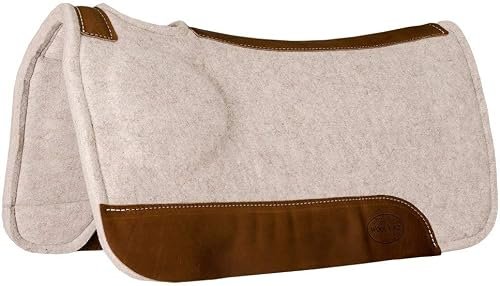
Finding the right gear depends on your horse’s unique shape and saddle fit. Whether you need to fix balance, cushion a sensitive spine, or fill gaps from muscle atrophy, the ideal choice depends on construction and discipline. For comprehensive correction, the Mustang Contoured Correction Pad is a frequent starting point, while the Wither Relief Bump Pad offers simple, adjustable balance.
As an Amazon Associate, we earn from qualifying purchases. This post contains affiliate links – if you buy through them, we may earn a commission at no extra cost to you.
1. Mustang Contoured Correction Fit Pad w/Tan Wool

Best for: Riders needing a professional-grade solution for complex saddle fit challenges.
This pad is built for horses that have asymmetrical muscle development or narrow shoulders, which often lead to saddle slippage or pressure points. The inclusion of XRD technology is designed to absorb significant force, aiming to protect the horse’s back during intense work. Because it’s contoured, it sits closer to the horse’s spine, providing a more stable base than flat, non-shaped pads.
The material choice is focused on orthopedic-grade wool, which offers natural cushioning. This pad is intended for those who deal with hard-to-fit conformation regularly. It isn’t for someone looking for a lightweight or minimalist pad, as the build-up is substantial and designed for corrective use rather than everyday trail riding.
Good if:
- You’re dealing with asymmetrical muscle development.
- Your saddle currently causes shoulder strain or pressure.
- You need a pad built for high-impact protection.
Skip it if:
- Your horse has a perfectly balanced conformation.
- You prefer a thin, lightweight pad for schooling.
2. Southwestern Equine OrthoRide Made in USA Premium All Wool Build

Best for: Owners of young, developing horses with changing muscle structures.
This pad addresses the common problem of saddles rubbing against the withers of young horses. By using PORON-RXD technology under the saddle bars, it aims to distribute pressure evenly and absorb shock during high-intensity activities like barrel racing or roping. It serves as a preventative measure to keep the horse comfortable as their muscles mature.
The pad is designed to solve fit problems before they lead to long-term soreness. It provides a specific buffer zone where the saddle bars typically make contact, which is vital for horses that lack the muscle mass to support a saddle naturally. It isn’t suitable for riders who want a pad that offers no thickness or those who don’t have a saddle fit issue to address.
Good if:
- You’re training a young horse with underdeveloped muscles.
- You participate in high-intensity Western disciplines.
- Your saddle currently rubs or pinches the wither area.
Skip it if:
- You only need a thin protective layer for a well-fitting saddle.
- You find thicker pads too bulky for your specific saddle.
3. Reinsman Open Wither Apex Saddle Pad

Best for: Horses with high withers or prominent spines needing extra clearance.
The Reinsman pad uses an anatomical design with an open channel at the front and back to physically lift the saddle away from the withers and spine. This is a deliberate choice to ensure the horse has maximum freedom of movement. The 3/4-inch pressed wool felt provides a dense, shock-absorbing surface that wicks away moisture to keep the horse dry.
The leather skirting and wear leathers add durability to high-friction areas, making it a rugged choice for ranch riding or long training sessions. It’s specifically engineered to prevent bridging, which occurs when a saddle makes contact at the front and back but not in the middle. It isn’t for riders who prefer synthetic materials or who don’t have a saddle clearance issue.
Good if:
- Your saddle is prone to bridging on your horse’s back.
- You work your horse for long periods and need moisture-wicking.
- You want a durable, long-lasting wool construction.
Skip it if:
- You prefer a sheepskin or synthetic material for softness.
- Your horse has low withers and doesn’t need the open channel.
4. ECP Equine Comfort Products 100% Australian Merino Sheepskin Half Saddle

Best for: Horses with sensitive skin that require therapeutic, plush comfort.
This half pad uses Australian Merino sheepskin to provide a soft, breathable layer between the saddle and the horse. The ergonomic wither relief cutout is designed to reduce pressure points, making it a strong choice for horses that are sensitive or prone to soreness. It’s versatile enough to be used alone or layered under another pad.
The sheepskin naturally regulates heat and absorbs sweat, which is a significant advantage for long or intense rides in warm conditions. The quilted cotton top adds structure, helping the pad maintain its shape during repeated use. It isn’t for riders who need a heavy-duty, corrective shim system, as this is more about comfort and pressure distribution than building up a saddle.
Good if:
- Your horse has very sensitive skin or a sensitive back.
- You ride for long durations and want to manage heat.
- You want a pad that’s easy to machine wash.
Skip it if:
- You need a heavy-duty correction pad to fix a poor fit.
- You prefer a thicker, more rigid build-up material.
5. Harrison Howard All Purpose Saddle Pad

Best for: English riders looking for a balanced, everyday training pad.
This pad is designed specifically for English saddles, focusing on a contoured spine and soft fleece at the wither to prevent rubbing. The waffle-weave lining is a key feature, as it wicks moisture away and dries quickly after schooling sessions. It offers a balanced support system that isn’t overly bulky, making it ideal for daily barn routines.
Because it’s designed for all-purpose use, it provides consistent support without restricting the horse during varied training exercises. It is designed to maintain its structure through regular use. It isn’t for Western riders or those who need deep shims to correct a major saddle imbalance.
Good if:
- You ride in an English saddle every day.
- You need a breathable pad for intense schooling sessions.
- You want something easy to clean and maintain.
Skip it if:
- You use a Western saddle.
- You need significant height adjustment for your saddle.
6. Showman Felt and Neoprene Wither Build Up Pad

Best for: Riders who need a simple, effective fix.
This pad is a straightforward solution for horses that need a little extra height at the wither. It combines felt and neoprene to provide a modest lift, helping to prevent the saddle from resting directly on the horse’s sensitive anatomy. It’s a no-frills tool designed to solve a specific, singular problem.
Because it’s so focused on the wither area, it’s very easy to place and adjust under a saddle. It’s a good choice for someone who is waiting for a saddle fitter or who only needs a minor correction. It isn’t for riders who need a full-coverage pad with advanced shock-absorbing technology or specialized moisture-wicking materials.
Good if:
- Your horse is high-withered and needs a minor lift.
- You want a pad that’s easy to position quickly.
Skip it if:
- You need extensive back protection or advanced shock absorption.
- You prefer a full-length, high-end wool pad.
7. Wither Relief Bump Pad

Best for: Riders needing to adjust saddle balance on the fly.
This bump pad is designed to lift the front of the saddle, which can instantly stop pinching and slipping. By allowing for a custom fit, it helps combat issues like muscle atrophy where the saddle has lost its proper seat. The breathable material ensures that the horse stays cool, even when the pad is used as part of a larger shimming system.
The versatility of this product is its primary strength, as it can be used with different riding styles to maintain stability. It’s a practical tool for riders who need to improve their horse’s comfort without replacing their entire saddle. It isn’t for riders who want a permanent, all-in-one pad, as this requires careful placement and monitoring to ensure it stays in the correct position.
Good if:
- You need to adjust the balance of your saddle quickly.
- Your horse has experienced muscle atrophy behind the shoulders.
- You want a breathable solution for trail riding or competition.
Skip it if:
- You prefer a single, integrated pad that doesn’t require shimming.
- You aren’t comfortable adjusting your saddle’s balance manually.
Where These Overlap
Most of these pads share the goal of protecting the wither, but they achieve it through different technical approaches. The Mustang Contoured Correction Pad and the Southwestern Equine OrthoRide Pad both prioritize high-tech impact absorption, making them the most similar in terms of their intended “corrective” function. If you’re choosing between these two, the decision comes down to the specific material—wool versus synthetic—and the type of riding you do.
Conversely, the Reinsman Open Wither Pad and the Harrison Howard Wither Pad are quite different. The Reinsman is a heavy-duty, anatomical wool pad for Western work, while the Harrison Howard is a lightweight, English-style pad for daily schooling. They overlap in their focus on spine clearance, but they’re built for entirely different saddles and riding habits. Choosing between them is less about the technical merit and more about the discipline you practice.
Still Not Sure?
How often will I really use this?
If you’re training a young horse or riding multiple horses daily, you need a durable, long-lasting pad like the Reinsman Open Wither Pad. Frequent use demands high-quality materials that won’t compress or lose their shape after a few weeks. If you only ride occasionally, a simpler option like the Showman Wither Build Up may be perfectly sufficient for your needs.
What do I already own that this has to work with?
Think about your current saddle and the shape of your horse’s back. If you use an English saddle, you must choose an English-specific pad like the Harrison Howard Wither Pad to ensure the billets and girth remain properly positioned. If you’re using a Western saddle, you need a pad with enough length and thickness, such as the Mustang Contoured Correction Pad, to handle the larger saddle bars.
What am I most likely to regret choosing?
The most common regret is buying a pad that’s too thick or too thin for your specific saddle fit. If you add too much bulk under a saddle that already fits well, you’ll create new pressure points. Always assess your current saddle clearance before buying. For balancing a saddle that’s dipping at the front, the Wither Relief Bump Pad is the most adjustable choice.
Frequently Asked Questions
Do I need a special pad for horses with low withers?
Horses with low withers often have a flatter back profile, which means they don’t need the same high-wither clearance as others. Instead, they often require a pad that provides stability to prevent the saddle from sliding forward. While many pads listed here are for high withers, the University of Minnesota Extension provides guidance on how proper saddle fit and padding ensure the horse remains comfortable under a heavy load.
Can I use these pads with any type of saddle?
No, the pads are generally split by discipline. Western pads like the Mustang Contoured Correction Pad are shaped for wider, longer saddle bars, while English pads like the Harrison Howard Wither Pad are designed for slimmer panels. Using the wrong pad can interfere with your ability to cue the horse, as the added bulk or incorrect contour can block your leg signals or shift the saddle’s center of gravity.
How do I know if a pad is effectively fixing the fit?
A pad is working if the saddle remains stable and the horse doesn’t show signs of soreness after being untacked. You should look for even sweat marks under the saddle; dry spots can indicate areas of excessive pressure, while overly wet spots might show where the saddle is rubbing. If the horse moves freely and doesn’t pin its ears or hollow its back when you girth up, the fit is likely improved.
Should I choose sheepskin or wool felt?
Sheepskin, like the ECP Merino Sheepskin Pad, offers superior softness and heat management, making it excellent for sensitive-skinned horses. Wool felt, like the Reinsman Open Wither Pad, is firmer and provides more structural support for corrective purposes. If your priority is therapeutic comfort, go with sheepskin; if your priority is correcting a saddle fit issue or providing rigid support, choose wool felt.
Conclusion
The best choice for your horse rests on the specific fit challenge you face. If you need a robust, corrective solution for Western riding, the Mustang Contoured Correction Pad is a reliable path forward. For English riders seeking daily comfort and moisture management, the Harrison Howard Wither Pad remains a standard choice. Start by checking your current saddle clearance, then select the pad that matches your primary discipline and horse’s sensitivity.


